Article 6.4: A New Opportunity for Cement Decarbonization
Key Takeaways
- Carbon credits are one of several instruments for decarbonizing cement, alongside environmental attribute certificates (EACs) and direct procurement of lower-carbon products. Each serves a different purpose, and buyers and developers should understand how they interact before engaging.
- Article 6.4 of the Paris Agreement is becoming a reference point for public and private carbon credit procurement, so the quality of its methodologies now holds significant weight.
- Proposed methodology A6.4-PMM010 - Partial substitution of fossil fuels by MSW in cement manufacture largely aligns with Relae and Microsoft’s Criteria for High-Quality EACs in the Concrete and Steel Sectors. However, Relae identified opportunities to strengthen provisions addressing interactions between carbon credits and environmental product declaration (EDP), where credited reductions are deducted from the product's EPD, with the aim of reducing the risk of the same mitigation being claimed more than once.
Article 6.4 Joins the Cement Decarbonization Toolkit
Article 6.4 of the Paris Agreement is expanding the financing options for decarbonizing cement and concrete. Environmental attribute certificates (EACs) let buyers pay for lower-carbon production without taking physical delivery of the product, while carbon credit methodologies reward manufacturers for storing captured CO2 in their products.
Relae is actively shaping this market: conducting technical diligence for buyers of cement EACs, providing project assurance and go-to-market support for industrial decarbonization projects, and leading market development through the publication of the Criteria for High-Quality EACs in the Concrete and Steel Sectors, in collaboration with Microsoft.
To build on these efforts, Relae (as Carbon Direct) recently participated in the public consultation for a proposed carbon credit methodology under the Paris Agreement Crediting Mechanism (PACM). Methodology A6.4-PMM010 would credit emissions reductions from replacing fossil fuels with municipal solid waste (MSW) in the production of cement clinker. The approach was proposed by the Inter-American Cement Federation (FICEM), which in 2026 partnered with the UN Industrial Development Organization to work to decarbonize the sector across Latin America.
The PACM, established under Article 6.4 of the Paris Agreement, could underpin national climate strategies and voluntary offsetting demand for years to come. One potential avenue of influence is the SBTi Corporate Net Zero Standard V2.0, which has introduced formal recognition of market-based instruments. As both public and private entities weigh their carbon credit procurement options, this is a critical juncture for getting the methodologies right.
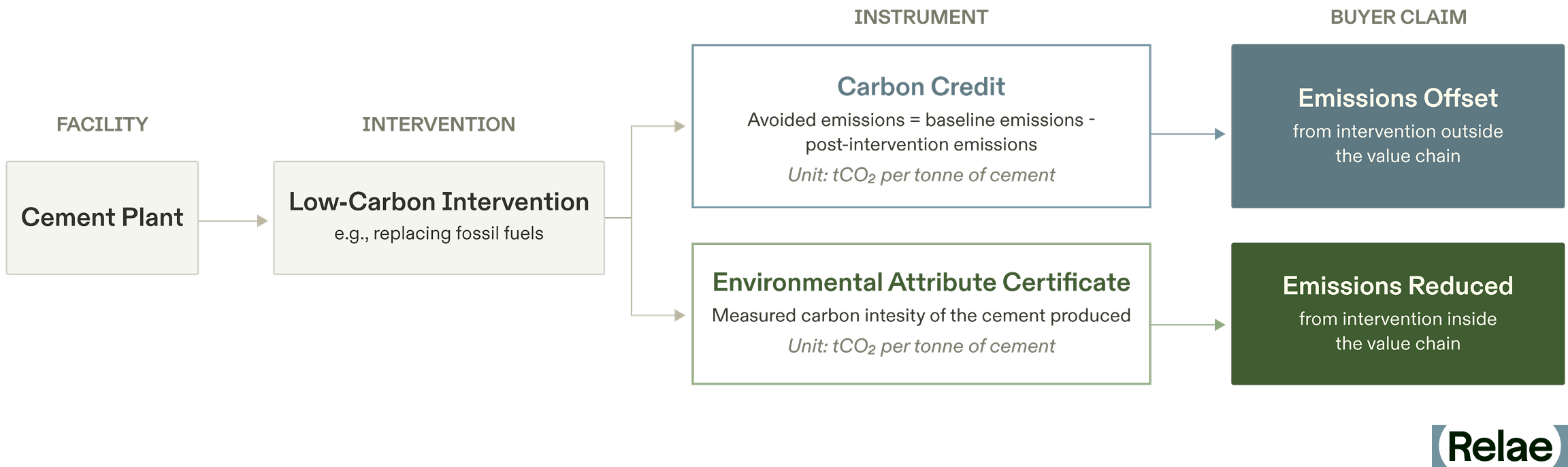
Two Key Options for Decarbonizing Cement: Carbon Credits and EACs
Concrete and steel are indispensable to modern construction and together account for approximately 13% of global CO2 emissions. With demand for infrastructure continuing to rise, including via data centers, decarbonizing these sectors is essential for new construction to remain consistent with climate commitments.
Carbon credits are one route to financing that work. A credit is issued for each tonne of emissions reduced below a baseline, meaning the emissions that would have occurred without the intervention. For a cement plant, credits might be issued for switching to low-carbon fuels or installing new equipment that reduces emissions. Companies buy credits to offset emissions outside their own value chains, and in doing so channel finance to projects that would not otherwise proceed.
EACs are a second route, and one that Relae is helping to shape. An EAC assigns a measured environmental characteristic to a unit of product (e.g., tonnes of CO2 per tonne of cement), usually established through an attributional life cycle assessment. The buyer pays for the lower-carbon attribute of a product and reports it against its own value chain emissions, which makes EACs a tool for scope 3 decarbonization rather than for offsetting.
While methodology A6.4-PMM010 is for carbon credits, we use the Relae EAC criteria as our reference point, as both instruments depend on the same foundations. An intervention must be traceable to a specific facility, the carbon impact must be quantifiable with a defensible method, and the project must be assessed for its social and environmental harms and benefits. The criteria set out in depth how Relae tests those foundations for an EAC claim, and the same tests apply with little adjustment to a crediting methodology.
Regardless of the preferred market instrument, replacing fossil fuels in cement production should be read as a partial solution. Kiln fuel combustion accounts for roughly 35% of the CO₂ emitted in clinker production, while the remaining 65% arises from process emissions inherent to calcination: when the heated limestone breaks down into lime and releases CO2 as a byproduct. As such, Relae considers this as part of a multi-step decarbonization strategy that should ultimately address calcination emissions through carbon capture, novel binders, or substitution of the clinker itself.
Why the PACM Matters for Carbon Credit Buyers
While there is a lack of supply today, PACM credits have the potential to underpin carbon credit demand. Corporate buyers looking to make recognized offsetting claims have reason to favor units issued under a government-endorsed UNFCCC mechanism. The European Climate Law references Article 6.4 quality standards, and the EU is expected to tie the eligibility of procured international credits to its methodologies. The German federal government has used UN-recognized credits to offset its business travel emissions since 2014, and UK government agencies have also sought PACM credits to fulfill their offsetting needs.
A strength of the PACM is its centralized structure. The 12-person Supervisory Body (SB) makes all final approvals, following methodology recommendations from the Methodological Expert Panel (MEP). All methodologies draw on the same Article 6.4 standards and tools. For example, A6.4-PMM010 relies heavily on the Standard on Baselines and the Tool on Emissions from Solid Waste Disposal Sites. Together, these can be used to calculate the counterfactual emissions from waste diverted from landfill, and dictate how to monitor waste conditions over the crediting period.
The potential for the PACM to scale is conditional. As the market matures, voluntary buyers can choose from a widening range of high-quality carbon credits. Moreover, the European Commission has shown, via its criticism of CORSIA, that the EU will make robust efforts to prohibit procurement from projects it considers flawed. As such, the PACM will only succeed if it provides compelling methodologies to accompany solid governance. That is the standard against which Relae reviewed the fossil fuel substitution methodology.
Relae’s Response to the Cement Methodology A6.4-PMM010
Alignment With Our High-Quality Criteria
We found methodology A6.4-PMM010 for carbon credits to largely align with our high-quality criteria. Certain gaps in the methodology are addressed by the Article 6.4 standards and tools it references, and the combination provides additional safeguards intended to support robust integrity.
In both the methodology and our criteria, additionality must be shown on regulatory, financial, and common practice grounds. Crediting is limited to the capacity installed at validation, so carbon finance improves existing production rather than funding new clinker capacity, which aligns with our catalytic impact criterion. The methodology also credits both displaced fossil fuel and avoided landfill methane, a dual benefit that strengthens the case for these projects, especially where landfill sites are poorly managed (e.g., do not flare methane).
We proposed only two major refinements: updating the landfill methane baseline at each verification, and closing the double-counting gap with environmental product declarations (EPDs).
Landfill Methane Baseline
Under Article 6.4, an independent verifier checks a project’s reported results for each monitoring period before new credits are issued. Relae proposed that the landfill methane baseline be re-established at each of these verifications: from site measurements where available, and by re-selecting the default value to match current conditions where they are not.
The baseline rests on two factors that can shift as a waste disposal site is capped, compacted, or drained: the oxidation factor (the share of methane absorbed by landfill cover before release), and the methane correction factor (how much of the waste decomposes without oxygen).
The Article 6.4 Tool on Emissions from Solid Waste Disposal Sites offers measured and default routes for setting these values, but the methodology does not specify which applies. A project developer could apply default values from the tool and leave them static for the whole crediting period. Re-selecting those values at each verification, rather than locking them in at the outset, keeps the baseline tied to how the site is actually performing throughout its crediting period.
Double-Counting Concerns
The Article 6.4 Activity Standard rightly requires that issued credits do not overlap with other emissions mitigation crediting schemes. However, the A6.4-PMM010 does not explicitly say how that applies to EPDs, which report a cement product's carbon intensity. Relae proposed closing that gap directly: the EPD should report the new, lower carbon intensity achieved after the intervention without subtracting the avoided emissions again. The methodology should also require an annual declaration confirming that the credit and the EPD aren’t claiming the same reduction twice.
An EPD reports a cement product’s carbon intensity, so a lower-carbon cement can earn value in two places at once: through the carbon credit, and through the EPD itself, which is exactly where the double-counting risk sits. EPD standards already keep the avoided emissions out of a product’s carbon intensity, reporting them separately from the product’s life-cycle stages, but A6.4-PMM010 never references that separation.
Explicitly addressing this distinction in the methodology, and pairing it with Relae’s proposed annual declaration, could strengthen transparency and reduce the risk of overlapping claims associated with the same emissions reductions, where the same emissions reduction can’t be claimed once through the credit and again through the product’s own carbon footprint.
How Relae Can Help
A6.4-PMM010 is a well-designed methodology, but market-based mechanisms for enabling cement decarbonization are evolving faster than practical guidance on how to use them credibly. Relae works with buyers and cement producers navigating this landscape. For buyers, we conduct technical due diligence, advise on procurement strategy, and guide robust claims. For producers and project developers, we assess which market-based mechanism suits a given plant and provide the analytical, market intelligence, and go-to-market support needed to monetize the chosen mechanisms credibly.
Frequently Asked Questions
What is the difference between a carbon credit and an Environmental Attribute Certificate (EAC)?
A carbon credit represents one tonne of emissions reduced below a baseline, and a buyer uses it to offset emissions outside their value chain. An EAC attaches a measured carbon attribute to a unit of product, such as cement, which the buyer reports against its own scope 3 emissions rather than for offsetting.
What is the relationship between Article 6.4 of the Paris Agreement and the Paris Agreement Crediting Mechanism (PACM)?
Article 6.4 of the Paris Agreement establishes the PACM, which refers to the registry itself along with the methodologies, standards, and tools that govern the credits listed on it. Article 6.4 is the treaty provision, and PACM is the mechanism built under it, so people often use the two terms interchangeably.
How do PACM credits differ from other credits available on the voluntary carbon market (VCM)?
PACM methodologies and standards are developed through a transparent UNFCCC process, which sets them apart from most VCM credits. This does not make PACM credits inherently higher quality, but some buyers, especially governments, prefer to tie procurement to PACM standards. Another key difference is that 7% of PACM credits are deducted at issuance–5% are transferred to the UN Adaptation Fund, and 2% are cancelled for overall mitigation.
Environmental Markets
Relae guides buyers, investors, producers, and project developers through the market instruments designed to mitigate environmental impacts. Our work combines science-based quality criteria, project-level diligence, market and policy intelligence, and commercial execution to help you make defensible decisions, capture green premiums, and finance the clean energy transition.
2026 Criteria for High-Quality Carbon Dioxide Removal



Katherine Vaz Gomes, PhD

Katherine Vaz Gomes, PhD
,

Katherine Vaz Gomes is a senior decarbonization engineer dedicated to advancing carbon management solutions that bridge scientific innovation with real-world implementation. With a background in chemical and biomolecular engineering, she specializes in carbon mineralization, critical mineral extraction, and techno-economic assessment of emerging decarbonization technologies.
At Relae, Katherine advises clients on the technologies to reduce the emissions of cement, concrete, and mining while maintaining economic growth. She works on strategies to lower the carbon intensity of concrete by integrating carbon mineralization into cement production and utilizing industrial waste streams as feedstocks for carbon removal. Her expertise in circular economy principles helps industries scale up low-carbon solutions by repurposing byproducts from mining and industrial processes into valuable materials.
Katherine conducts due diligence on carbon management projects, ensuring that emerging technologies are scientifically robust, economically viable, and scalable. She also supports decarbonization strategies for the mining sector, evaluating pathways to capture and store carbon in mine tailings while extracting critical minerals essential for the energy transition.
Katherine received a PhD in Chemical Engineering at the University of Pennsylvania, with a focus on the process engineering, techno economics, and government regulations involved in using mining waste to store greenhouse gases and produce critical minerals.
Critical Mineral Leadership Academy, Inaugural Cohort
Columbia University Women in Energy Fellowship, 2026 Cohort

Chimdi Obienu

Chimdi Obienu
,
Before Relae, Chimdi worked as the Carbon Markets Data and Policy Lead at EcoAct (part of Schneider Electric), where he created the knowledge management system covering frameworks such as CORSIA, Article 6 of the Paris Agreement, and the ICVCM Core Carbon Principles. As part of the Research and Innovation Team, he built scenario modeling tools to quantify the exposure to regulatory carbon pricing mechanisms, such as the EU ETS and CBAM, as well as the costs of assorted carbon offsetting approaches.
At EcoAct, Chimdi also worked as a sustainability consultant, supporting clients with GHG inventory accounting, environmental disclosures (e.g., CDP), and the development of decarbonization strategies.
Chimdi began his career in Washington DC, advising clients on policy developments and technology innovation across the energy and transportation sectors.
Best Student, University of Sussex MSc in Energy Policy
What to Read Next
The New Nasdaq Issuance Calendar Advances Transparency in the Carbon Removal Market
Key Takeaways
- The Nasdaq Carbon Issuance Calendar, a new data platform, provides carbon removal buyers and suppliers with standardized information on future offtake availability, indicative pricing, and project maturity. The platform was developed in collaboration with Relae, formerly Carbon Direct.
- The Carbon Issuance Calendar addresses the fragmentation and transparency problems of the voluntary carbon market by centralizing standardized project data and embedding our scientific diligence framework, built over 900 project reviews, giving buyers delivery-risk insight that no registry or marketplace offers today.
- The Carbon Issuance Calendar is an important early step, not the whole journey: it shows buyers what durable tonnes exist and allows them to compare projects with apples-to-apples data.
- Buyers can move from the Carbon Issuance Calendar into technical diligence, contracting, and project assurance with Relae’s advisory team. Suppliers can register to connect with buyers who are ready to engage.
Carbon Removal Project Data Has a Visibility Problem
If you're sourcing durable carbon removal credits, you may run into a familiar wall: project data scattered across dozens of developer websites, presented in inconsistent formats, with no easy way to compare one project against another. If you're a project developer, you face the mirror image of that problem: fielding individual requests for proposals, with no central place to showcase your available tonnes.
Get this wrong, and buyers may end up counting on carbon removal that never shows up - the delivery risk bugbear.
Between 2022 and 2024, high-durability engineered carbon removal made up just 2 percent of all carbon credit issuances. They remain in short supply, particularly the high-quality supply corporate buyers need. The gap is set to widen: our 2026 State of the Voluntary Carbon Market report found that more than 80% of the 2030 high-durability carbon removal projects are at risk of stalling and failing without additional offtake and financing commitments.
The Nasdaq Carbon Issuance Calendar, developed by Nasdaq in collaboration with Relae, offers an important first step toward addressing this information gap.
What Is the Nasdaq Carbon Issuance Calendar?
The Carbon Issuance Calendar is a centralized, accessible dashboard where carbon removal buyers and suppliers view standardized project data: future credit availability, indicative pricing, and project delivery status, all in one place.
The Nasdaq Carbon Issuance Calendar combines structured, developer-provided project data with project maturity assessment informed by Relae’s assessment framework and technical diligence. This helps users understand future CDR availability, indicative pricing, and potential project delivery risk through a single platform.
This expertise didn't appear overnight. It comes from sitting across the table with developers, stress-testing their science, mapping their delivery timelines against reality, and helping them show up to buyers as credible partners. The result is a track record that gives the framework embedded in the Carbon Issuance Calendar its depth. It's a starting point, built for buyers and suppliers to find each other on the basis of consistent, comparable information, using international class financial and information infrastructure.
How Buyers Should Use the Nasdaq Carbon Issuance Calendar
Today, if you're trying to procure durable carbon removal credits, you have no single place to start. You have to visit individual developer sites, request information through scattered channels, and compare projects that present data in entirely different formats before diligence has even begun. In many cases, you are comparing apples to oranges - different kinds of CDR projects with different durabilities, risks, and overall quality.
The Carbon Issuance Calendar provides a central starting point. You can view future credit availability, compare indicative pricing across projects, and begin assessing options without contacting each supplier one by one.
More importantly, the Carbon Issuance Calendar frames the data. Our scientists developed a delivery-oriented lens, built from reviewing over 900 carbon removal projects, drawing on the same rigor behind our Criteria for High-Quality Carbon Dioxide Removal, which we develop annually with Microsoft.
How Suppliers Reach Buyers Through the Carbon Issuance Calendar
If you're a project developer, the Nasdaq Carbon Issuance Calendar tackles visibility, one of the most persistent barriers to market access. You can list available tonnes, display indicative pricing, and reach a global audience of corporate and financial buyers at no cost.
The timing matters. Many first-of-a-kind engineered carbon removal projects are preparing to break ground and need bankable offtake agreements to secure financing before they can do so (a key aspect of CDR 2.0). Our analysis of approximately 140 high-durability carbon removal project developers found scale-up plans for 30 million tonnes of supply per year. Reaching that potential will take real demand: committed forward offtake, increased project equity investment, and access to lending.
Register now: you'll be positioned to connect to buyers actively looking to engage.
How Does the Carbon Issuance Calendar Differ From a Carbon Credit Registry or Carbon Removal Marketplace?
The Carbon Issuance Calendar solves a distinct, early-stage problem. It gives buyers and suppliers a centralized place to find each other and compare options against standardized information, something neither a registry nor a marketplace is built to do.
For a closer look at how registries differ and what you should weigh when navigating them, read our Navigating Carbon Credit Registries report.
Scientific Diligence Turns Visibility Into Confidence
Standardized data tells you what exists. Scientific diligence tells you what's worth pursuing.
Relae’s scientists do that work every day. Our experts apply rigorous pathway-specific criteria to live projects, evaluating delivery risk and status, and identifying where questions remain is the core of what we bring to the carbon removal market.
The Carbon Issuance Calendar puts an accessible version of that expertise at the top of the procurement funnel. It’s for everyone in the market - you don't need to be a carbon removal scientist to use it. This snapshot allows you to compare projects against each other, giving you a meaningful starting point before deeper diligence begins.
Want to go deeper on a specific project? Relae’s technical diligence team picks up right where the Carbon Issuance Calendar leaves off.
What Carbon Removal Projects Are on the Carbon Issuance Calendar Today?
The Carbon Issuance Calendar currently features engineered and hybrid carbon removal projects: direct air capture, biochar, enhanced rock weathering, and bioenergy with carbon capture and storage. These high-durability pathways offer permanence on the order of hundreds to thousands of years.
Many of these projects are at an inflection point: they’re ready to scale but dependent on committed offtake to unlock financing. The Calendar serves their needs, and the buyer’s needs, together.
Nature-based carbon removals have their own criteria and market dynamics. They may appear in a separate segment of the Carbon Issuance Calendar down the line.
From the Carbon Issuance Calendar to Completed Carbon Removal Procurement
If you're building or refining a carbon removal procurement strategy, the Carbon Issuance Calendar is the right place to start.
From there, you can choose to work with the Relae advisory team to support every later stage: technical diligence on specific projects, contracting and negotiation support, ongoing project assurance, and access to curated carbon credit sourcing. The Carbon Issuance Calendar surfaces the market; we help you navigate it, connecting you with the right developers, on the right terms, with the scientific confidence to move forward.
Moving from commitment to delivery takes structural change across the market, too—our CDR 2.0 white paper lays out the five pillars we see as essential to getting engineered and hybrid carbon removal projects built and delivering.
Article 6.4: A New Opportunity for Cement Decarbonization
Key Takeaways
- Carbon credits are one of several instruments for decarbonizing cement, alongside environmental attribute certificates (EACs) and direct procurement of lower-carbon products. Each serves a different purpose, and buyers and developers should understand how they interact before engaging.
- Article 6.4 of the Paris Agreement is becoming a reference point for public and private carbon credit procurement, so the quality of its methodologies now holds significant weight.
- Proposed methodology A6.4-PMM010 - Partial substitution of fossil fuels by MSW in cement manufacture largely aligns with Relae and Microsoft’s Criteria for High-Quality EACs in the Concrete and Steel Sectors. However, Relae identified opportunities to strengthen provisions addressing interactions between carbon credits and environmental product declaration (EDP), where credited reductions are deducted from the product's EPD, with the aim of reducing the risk of the same mitigation being claimed more than once.
Article 6.4 Joins the Cement Decarbonization Toolkit
Article 6.4 of the Paris Agreement is expanding the financing options for decarbonizing cement and concrete. Environmental attribute certificates (EACs) let buyers pay for lower-carbon production without taking physical delivery of the product, while carbon credit methodologies reward manufacturers for storing captured CO2 in their products.
Relae is actively shaping this market: conducting technical diligence for buyers of cement EACs, providing project assurance and go-to-market support for industrial decarbonization projects, and leading market development through the publication of the Criteria for High-Quality EACs in the Concrete and Steel Sectors, in collaboration with Microsoft.
To build on these efforts, Relae (as Carbon Direct) recently participated in the public consultation for a proposed carbon credit methodology under the Paris Agreement Crediting Mechanism (PACM). Methodology A6.4-PMM010 would credit emissions reductions from replacing fossil fuels with municipal solid waste (MSW) in the production of cement clinker. The approach was proposed by the Inter-American Cement Federation (FICEM), which in 2026 partnered with the UN Industrial Development Organization to work to decarbonize the sector across Latin America.
The PACM, established under Article 6.4 of the Paris Agreement, could underpin national climate strategies and voluntary offsetting demand for years to come. One potential avenue of influence is the SBTi Corporate Net Zero Standard V2.0, which has introduced formal recognition of market-based instruments. As both public and private entities weigh their carbon credit procurement options, this is a critical juncture for getting the methodologies right.
Two Key Options for Decarbonizing Cement: Carbon Credits and EACs
Concrete and steel are indispensable to modern construction and together account for approximately 13% of global CO2 emissions. With demand for infrastructure continuing to rise, including via data centers, decarbonizing these sectors is essential for new construction to remain consistent with climate commitments.
Carbon credits are one route to financing that work. A credit is issued for each tonne of emissions reduced below a baseline, meaning the emissions that would have occurred without the intervention. For a cement plant, credits might be issued for switching to low-carbon fuels or installing new equipment that reduces emissions. Companies buy credits to offset emissions outside their own value chains, and in doing so channel finance to projects that would not otherwise proceed.
EACs are a second route, and one that Relae is helping to shape. An EAC assigns a measured environmental characteristic to a unit of product (e.g., tonnes of CO2 per tonne of cement), usually established through an attributional life cycle assessment. The buyer pays for the lower-carbon attribute of a product and reports it against its own value chain emissions, which makes EACs a tool for scope 3 decarbonization rather than for offsetting.
While methodology A6.4-PMM010 is for carbon credits, we use the Relae EAC criteria as our reference point, as both instruments depend on the same foundations. An intervention must be traceable to a specific facility, the carbon impact must be quantifiable with a defensible method, and the project must be assessed for its social and environmental harms and benefits. The criteria set out in depth how Relae tests those foundations for an EAC claim, and the same tests apply with little adjustment to a crediting methodology.
Regardless of the preferred market instrument, replacing fossil fuels in cement production should be read as a partial solution. Kiln fuel combustion accounts for roughly 35% of the CO₂ emitted in clinker production, while the remaining 65% arises from process emissions inherent to calcination: when the heated limestone breaks down into lime and releases CO2 as a byproduct. As such, Relae considers this as part of a multi-step decarbonization strategy that should ultimately address calcination emissions through carbon capture, novel binders, or substitution of the clinker itself.
Why the PACM Matters for Carbon Credit Buyers
While there is a lack of supply today, PACM credits have the potential to underpin carbon credit demand. Corporate buyers looking to make recognized offsetting claims have reason to favor units issued under a government-endorsed UNFCCC mechanism. The European Climate Law references Article 6.4 quality standards, and the EU is expected to tie the eligibility of procured international credits to its methodologies. The German federal government has used UN-recognized credits to offset its business travel emissions since 2014, and UK government agencies have also sought PACM credits to fulfill their offsetting needs.
A strength of the PACM is its centralized structure. The 12-person Supervisory Body (SB) makes all final approvals, following methodology recommendations from the Methodological Expert Panel (MEP). All methodologies draw on the same Article 6.4 standards and tools. For example, A6.4-PMM010 relies heavily on the Standard on Baselines and the Tool on Emissions from Solid Waste Disposal Sites. Together, these can be used to calculate the counterfactual emissions from waste diverted from landfill, and dictate how to monitor waste conditions over the crediting period.
The potential for the PACM to scale is conditional. As the market matures, voluntary buyers can choose from a widening range of high-quality carbon credits. Moreover, the European Commission has shown, via its criticism of CORSIA, that the EU will make robust efforts to prohibit procurement from projects it considers flawed. As such, the PACM will only succeed if it provides compelling methodologies to accompany solid governance. That is the standard against which Relae reviewed the fossil fuel substitution methodology.
Relae’s Response to the Cement Methodology A6.4-PMM010
Alignment With Our High-Quality Criteria
We found methodology A6.4-PMM010 for carbon credits to largely align with our high-quality criteria. Certain gaps in the methodology are addressed by the Article 6.4 standards and tools it references, and the combination provides additional safeguards intended to support robust integrity.
In both the methodology and our criteria, additionality must be shown on regulatory, financial, and common practice grounds. Crediting is limited to the capacity installed at validation, so carbon finance improves existing production rather than funding new clinker capacity, which aligns with our catalytic impact criterion. The methodology also credits both displaced fossil fuel and avoided landfill methane, a dual benefit that strengthens the case for these projects, especially where landfill sites are poorly managed (e.g., do not flare methane).
We proposed only two major refinements: updating the landfill methane baseline at each verification, and closing the double-counting gap with environmental product declarations (EPDs).
Landfill Methane Baseline
Under Article 6.4, an independent verifier checks a project’s reported results for each monitoring period before new credits are issued. Relae proposed that the landfill methane baseline be re-established at each of these verifications: from site measurements where available, and by re-selecting the default value to match current conditions where they are not.
The baseline rests on two factors that can shift as a waste disposal site is capped, compacted, or drained: the oxidation factor (the share of methane absorbed by landfill cover before release), and the methane correction factor (how much of the waste decomposes without oxygen).
The Article 6.4 Tool on Emissions from Solid Waste Disposal Sites offers measured and default routes for setting these values, but the methodology does not specify which applies. A project developer could apply default values from the tool and leave them static for the whole crediting period. Re-selecting those values at each verification, rather than locking them in at the outset, keeps the baseline tied to how the site is actually performing throughout its crediting period.
Double-Counting Concerns
The Article 6.4 Activity Standard rightly requires that issued credits do not overlap with other emissions mitigation crediting schemes. However, the A6.4-PMM010 does not explicitly say how that applies to EPDs, which report a cement product's carbon intensity. Relae proposed closing that gap directly: the EPD should report the new, lower carbon intensity achieved after the intervention without subtracting the avoided emissions again. The methodology should also require an annual declaration confirming that the credit and the EPD aren’t claiming the same reduction twice.
An EPD reports a cement product’s carbon intensity, so a lower-carbon cement can earn value in two places at once: through the carbon credit, and through the EPD itself, which is exactly where the double-counting risk sits. EPD standards already keep the avoided emissions out of a product’s carbon intensity, reporting them separately from the product’s life-cycle stages, but A6.4-PMM010 never references that separation.
Explicitly addressing this distinction in the methodology, and pairing it with Relae’s proposed annual declaration, could strengthen transparency and reduce the risk of overlapping claims associated with the same emissions reductions, where the same emissions reduction can’t be claimed once through the credit and again through the product’s own carbon footprint.
How Relae Can Help
A6.4-PMM010 is a well-designed methodology, but market-based mechanisms for enabling cement decarbonization are evolving faster than practical guidance on how to use them credibly. Relae works with buyers and cement producers navigating this landscape. For buyers, we conduct technical due diligence, advise on procurement strategy, and guide robust claims. For producers and project developers, we assess which market-based mechanism suits a given plant and provide the analytical, market intelligence, and go-to-market support needed to monetize the chosen mechanisms credibly.
Frequently Asked Questions
What is the difference between a carbon credit and an Environmental Attribute Certificate (EAC)?
A carbon credit represents one tonne of emissions reduced below a baseline, and a buyer uses it to offset emissions outside their value chain. An EAC attaches a measured carbon attribute to a unit of product, such as cement, which the buyer reports against its own scope 3 emissions rather than for offsetting.
What is the relationship between Article 6.4 of the Paris Agreement and the Paris Agreement Crediting Mechanism (PACM)?
Article 6.4 of the Paris Agreement establishes the PACM, which refers to the registry itself along with the methodologies, standards, and tools that govern the credits listed on it. Article 6.4 is the treaty provision, and PACM is the mechanism built under it, so people often use the two terms interchangeably.
How do PACM credits differ from other credits available on the voluntary carbon market (VCM)?
PACM methodologies and standards are developed through a transparent UNFCCC process, which sets them apart from most VCM credits. This does not make PACM credits inherently higher quality, but some buyers, especially governments, prefer to tie procurement to PACM standards. Another key difference is that 7% of PACM credits are deducted at issuance–5% are transferred to the UN Adaptation Fund, and 2% are cancelled for overall mitigation.
Carbon Removal, Reduction, and Avoidance Credits Explained
Key Takeaways
- Trust in carbon credits remains low. In part, this is because many mistakenly treat every credit type as interchangeable.
- Reduction, removal, and avoidance credits are verified against fundamentally different baselines, so credit quality must be judged based on type and project specifics, never with one blanket standard.
- The Integrity Council for the Voluntary Carbon Market's Core Carbon Principles now give buyers an independent bar to check against, including 44 methodologies approved across 13 eligible crediting programs, as of August 2026.
- Removal credits still make up only 5–6% of the market, even as compliance-driven demand accelerates, per our 2026 State of the Voluntary Carbon Market report.
Three Types of Carbon Credits: Reduction, Removal, and Avoidance
A carbon credit is a mechanism that allows one party to compensate another for their carbon mitigation activities. Based on their net emissions impact, there are three types of carbon credits: reduction, removal, and avoidance.
- Reduction credits reflect activities that decrease greenhouse gas emissions, compared to prior practices.
- Removal credits reflect activities that remove carbon dioxide already present in the atmosphere and oceans and lock it away for decades, centuries, or millennia.
- Avoidance credits reflect activities that prevent greenhouse gases from being emitted in the first place. For all three types, credits are assessed and issued by measuring or estimating how much carbon is reduced, removed, or avoided as a result of a credit purchase and its associated activities.
While credits are assessed in different ways depending on the type, one of the most important indicators of quality is a project's baseline - the emissions that would be present in a business-as-usual scenario, without action being taken to reduce, remove, or avoid them. Project developers use baselines as a means of comparison to assess the net emissions impact of a project.
- Baselines must be accurately set and data-driven.
- Emissions impacts of a project must be correctly calculated against its baseline.
Reduction, removal, and avoidance projects involve very different activities and, for some types of projects, it may be more challenging to establish an accurate baseline. However, without accurate baselines, climate impacts cannot be reliably determined.
Across the voluntary carbon market, Reduction credits represent roughly 20% of the purchases. Removal credits represent roughly 5% of the purchases. The remainder, roughly 75%, are avoidance credits.
Carbon Reduction Credits
Carbon reduction must drive the majority of our push to net zero, but translating carbon reduction activities into carbon credits that can be purchased is challenging. Examples of activities represented by carbon reduction credits include reducing fossil fuel use by improving fuel efficiency, or programs that reduce the methane that is generated from farms or municipal waste processing.
Reduction credits are measured and quantified against the baseline emissions of an existing technology or process. Some reduction credits are easy to track and measure, such as efficiency investments or destruction of fugitive methane. Other projects are more complex. For example, low-emission cookstove projects in developing regions rely on tracking patterns of cookstove use and quantifying emission factors for various fuel and stove combinations, both of which are hard to do. The result, as studies have shown, sometimes leads to overcrediting in reduction projects.
Superpollutant Credits
One class of reduction credit, superpollutant credits, has garnered recent attention. These credits involve the reduction of non-CO2 greenhouse gases with very strong radiative forcing, such as methane, nitrous oxides, or fluorinated gases like chlorofluorocarbons. These are not a substitute for CO2 removal, but can provide rapid and profound reductions at modest cost. Many different kinds of superpollutants exist in today’s market, worth roughly $60M today. Recent purchases by tech companies and others have highlighted the potential of these reduction credits.
Another class of reduction credit, transition credits, involves the deliberate early closure of emitting assets like coal-fired power plants or heavy manufacturing facilities. Early efforts by governments, banks, and companies around the world under the Just Energy Transition Partnership agreement jump-started transition credits as a concept at COP26. The Kinetic Coalition, in partnership with many groups including Relae, has launched work to bring transition credits to market with several pilot efforts, including closing a coal plant in the Philippines 10 years early.
Carbon Removal Credits
Projects that remove carbon come from a diverse set of solutions, from nature-based solutions like reforestation, to hybrid solutions like biochar, to engineered solutions such as direct air capture and storage. Roughly 5–6% of credits on the voluntary carbon market today are classified as removals, up from roughly 3% a few years ago.
Carbon removal baselines are determined differently depending on whether a project uses an engineered, hybrid, or nature-based solution. For engineered removals, the baseline is zero, because no carbon removal was occurring in the absence of the project. The credited removal will be the difference between the quantity of carbon removed and any emissions that occur to facilitate the removal (determined through a carbon credit life cycle assessment). Baselines for hybrid and nature-based removals can be more challenging. In natural systems, changes in carbon stocks created by removals must be measured and approximated over time, and creditable removals represent the additional carbon removed by the intervention relative to the baseline (e.g., fallow land versus a reforestation project).
Another important consideration for carbon removal credits is project durability, a measure of the likely duration of carbon storage. Stored carbon can re-enter the atmosphere either through deliberate actions (e.g., deforestation) or accidental ones (e.g., wildfires). Nature-based removals are especially vulnerable to being re-released and are usually considered less durable (i.e., stored for less than 50 years). In contrast, engineered solutions offer high durability (i.e., stored for hundreds to thousands of years), and hybrid removals also offer durability periods that are typically longer than those of nature-based removals.
While less durable, nature-based solutions are effective, cost-effective, and widely available today. They made up over 95% of all carbon removal credits issued in 2025. Engineered and hybrid solutions are more expensive and scarce but offer longer durability. Prices of engineered carbon removal are likely to fall with innovation and increased market participation, but are currently much higher than most nature-based credits. With SBTi's finalized Corporate Net-Zero Standard V2.0, this balance is likely to shift. Large companies must now purchase removal credits covering 1–100% of scope 1, scope 2, and scope 3 emissions between 2035 and their net-zero year, with an explicit focus on more durable CO2 removal credits.
Carbon Avoidance Credits
Examples of carbon avoidance include avoiding deforestation that would result in the release of carbon dioxide into the atmosphere or clean energy projects that avoid the release of emissions from burning fossil fuels in possible facilities. This can be confusing, since many avoided credits are called reduction credits, as is the case with projects under the Reducing Emissions from Deforestation and Forest Degradation (REDD+) framework. Avoidance credits make up roughly 75% of certified credits on the voluntary carbon market today - an overwhelming majority - in part due to high availability and low price.
Avoiding emissions is an important goal with numerous environmental, climate, community, and other benefits. Relae works with clients and customers across industries on developing and implementing strategies to avoid emissions within their value chain. However, there are significant challenges with the way that many carbon avoidance credits are created.
- Carbon avoidance credits are based on an estimate of the emissions that might have existed had a project not been funded. Because it is impossible to observe what might have happened in the absence of a project, carbon avoidance estimates are determined by considering historic data and contextual information. Statistical models can be used to create a presumed baseline that represents what would have happened in the absence of the project.
- Because the baseline is not observed in an avoided emissions project, there is uncertainty in calculating the number of carbon credits it produces. If the baseline is not set accurately, a project can overcredit. While the lack of a directly observed and measured baseline means avoidance credits will always have some degree of uncertainty, high-quality avoidance projects present compelling evidence to support their baselines, greatly reducing uncertainty.
New datasets, statistical techniques, and methodologies are providing opportunities for developing avoidance credits with more certainty. Three REDD+ methodologies have now cleared the Integrity Council for the Voluntary Carbon Market (ICVCM) assessment for its Core Carbon Principles (CCPs), a concrete sign that credit quality standards for avoidance projects are maturing.
Defining and Standardizing Quality in the Voluntary Carbon Market
Carbon credits are intended to reduce, remove, or avoid emissions. They pay for an environmental service that must be delivered. Companies working to generate climate benefits through credit purchases must grapple with the differences and uncertainties of credit quality to ensure that the intended benefits are realized.
While high-quality credits exist for all types of projects, a rich understanding of the differences in methodologies, geographies, physics, and ecology is required to identify high-quality projects and understand varied certainty, durability, and risk terms. Identifying high-quality carbon projects demands extensive and project-specific diligence beyond carbon market certification.
Our own diligence work reveals that high-quality projects can be hard to find. Fewer than 10% of the carbon removal projects we assessed for our 2026 State of the Voluntary Carbon Market report met our quality criteria. This diligence work now has an additional, independent backstop. As of August 2026, the ICVCM has approved 44 methodologies across 13 programs, as eligible for its CCP label, including ACR, Gold Standard, and VCS. For buyers, considering projects that are CCP-eligible should be used as a first filter—not a substitute for project-level diligence, but representing a legitimate floor.
While realized emissions impacts may be difficult to prove in some cases, it is important to remember that some projects provide additional co-benefits. REDD+ projects, for example, may have a positive impact on conservation and biodiversity, and cookstove projects may offer clear human health and social welfare benefits. However, these benefits should be assessed separately from carbon reduction, removal, or avoidance benefits.
Frequently Asked Questions
What's the difference between a carbon credit and a carbon offset?
A carbon credit represents one verified tonne of emissions reduced, removed, or avoided. A carbon offset describes how a buyer uses that credit, typically to counterbalance emissions it has not yet accounted for. The credit itself does not change type based on how it's claimed.
Which type of carbon credit—reduction, removal, or avoidance—is highest quality?
No single type is inherently highest quality. Each project, regardless of type, is verified against a defined baseline. Quality depends on how rigorously that specific baseline was set and how well the project meets other quality criteria. Removal credits from engineered sources have the most straightforward baseline (zero), and avoidance credits carry the most baseline uncertainty by design, but these are only one determinant of credit quality.
Do carbon removal credits automatically meet the ICVCM’s Core Carbon Principles?
No. The ICVCM assesses methodologies and programs, not individual projects. If a project uses a methodology that is eligible for the CCP label, this can be a useful floor but is not a guarantee of high quality.
How does SBTi's near-term removal mandate change which credits I should buy now?
SBTi's finalized Corporate Net-Zero Standard V2.0 doesn't require removal purchases until 2035, but it sets the ramp now (i.e., 1% of scope 1, scope 2, and scope 3 emissions in 2035, scaling to 100% by the net-zero year). This means the highest-durability removal supply that is scarcest and most in demand today is the same supply that many companies will need later. The SBTi guidelines are still changing, so buyers and project developers must track them closely.
The Sustainable Aviation Fuel Cost Premium Is Permanent
Key Takeaways
- Sustainable aviation fuel (SAF) will not reach price parity with fossil jet fuel under any realistic near-term scenario. The cost premium is structural—rooted in the chemistry of feedstocks—not a temporary artifact of early-stage markets.
- Neither airlines nor corporate buyers are purchasing SAF for its energy content. Both are buying sustainability claims: airlines for regulatory compliance and scope 1 credentials, corporates for scope 3 emissions reporting and social license to operate. The fuel is incidental to both transactions.
- Corporate offtakes can play a genuine role in building the SAF industry, but only if they create capacity that would not otherwise exist. Additionality is not a technicality; it is the entire value proposition.
- High-integrity SAF procurement requires evaluating not just carbon reduction, but feedstock sourcing, leakage, and social and environmental harms. The newly released Criteria for High-Quality Low Carbon Fuels from Relae (formerly Carbon Direct) provides a framework for doing this rigorously.
A Major Deal Illustrates How the SAF Market Really Works
On June 5, 2026, Google and American Airlines announced a three-year agreement under which Google will purchase sustainable aviation fuel (SAF) certificates (SAFc) associated with 35 million gallons of SAF. American will take physical delivery of the fuel at Chicago O'Hare. Google receives the emissions attributes. The arrangement relies on book-and-claim accounting, in which the physical fuel and the environmental attribute are legally separated and transferred to different parties.
The deal is a window into how the SAF market works, and what every company in the value chain needs to understand before entering it.
The SAF Cost Premium Is Structural, Not a Market Inefficiency
There is a persistent hope in the aviation industry that SAF will eventually reach price parity with fossil jet fuel. This will not happen, at least not through any mechanism that currently exists or is credibly in development.
The economics are the product of thermodynamics. Petroleum is pre-deoxygenated; over millions of years, heat and pressure stripped oxygen from biological material, concentrating energy into the hydrocarbons we pump out of the ground today. Bio-based SAF feedstocks, e.g., vegetable oils, agricultural residues, and other biomass, are oxygen-rich (carbohydrates, not hydrocarbons). Power-to-liquid e-fuels start from captured CO₂, which is fully oxidized.
Either way, every SAF production pathway must pay an energy debt to remove or chemically reduce that oxygen, in the form of hydrogen deoxygenation, energy inputs, and processing costs. This is not a manufacturing inefficiency that scale will solve. It is a constraint baked into the feedstocks themselves.
The numbers reflect this. According to the European Union Aviation Safety Agency (EASA), the average market price of SAF in 2025 was approximately €1,925 per tonne, roughly three times the €640 per tonne average for conventional jet fuel.
The cheapest pathway, hydroprocessed esters and fatty acids (HEFA), produced from waste oils like used cooking oil or tallow, represents almost all current SAF supply and sits at the lower end of the SAF cost range. Costlier cellulosic and e-fuel pathways push it higher. EASA estimates 2025 production costs for power-to-liquid e-fuels at €7,520 per tonne, more than ten times the cost of conventional kerosene. While these costs can and will come down, none are expected to approach price parity.
The feedstock ceiling compounds this. HEFA from waste oils is the cheapest SAF pathway, but waste oil supply is finite and competes with renewable diesel, which typically offers better margins for producers. As mandates push SAF volumes beyond what HEFA can supply, the industry must move to cellulosic biomass or power-to-liquid pathways, at progressively higher cost. Scaling the SAF industry does not automatically bring prices down. In the near term, it pushes them up.
Policy Determines Who Absorbs the Cost
If price parity is not coming, the cost premium lands somewhere. Two policy philosophies have emerged to answer that question.
Europe has largely adopted the polluter-pays principle: SAF mandates place the cost burden on fuel suppliers and, by extension, on airlines and their passengers. The EU's ReFuelEU Aviation regulation and the UK's SAF mandate both carry steep penalties for non-compliance. As Relae has documented, in the UK, those penalties range from three to 13 times the cost of compliance, depending on the obligation type and year, signaling that regulators are serious about pushing aviation toward sustainable fuels.
The United States approached the problem differently, leaning on taxpayer subsidies.The Inflation Reduction Act (IRA) 45Z Clean Fuel Production Credit and its predecessor, the 40B Sustainable Aviation Fuel Credit sought to socialize much of the cost premium. The appeal of this approach was that it made SAF economics viable without raising ticket prices. Its vulnerability was political: when the IRA's incentive landscape was revised, the project pipelines that had formed around those credits evaporated quickly. US taxpayer-funded support proved politically less durable than the UK and EU’s mandated compliance obligations.
Neither model works in isolation. Mandates without bankable project finance generate demand signals but no new supply. Incentives without policy durability attract project interest but cannot get facilities to final investment decisions. The deals that have actually moved capital combine a stable policy floor, whether mandate or incentive, with long-term private commitments that provide the revenue certainty project finance requires.
The Google-American Airlines deal illustrates the incentives-plus-private-commitment structure. The deal explicitly credits the Illinois SAF tax credit as the enabling policy lever. HEFA SAF of this type is eligible to generate Renewable Fuel Standard credits (RINs), and fuel produced from 2025 onward qualifies for the IRA's 45Z Clean Fuel Production Credit. This stack provides additional floor economics. The corporate offtake completes the structure by delivering the revenue certainty that volatile policy credits alone cannot. Remove any one of those elements and the deal's economics likely do not hold.
Nobody in this Market Is Buying SAF for its Energy Content
This is the key to understanding how the SAF market works. Neither airlines nor corporate buyers purchase SAF for its energy content. Airports have kerosene. Airlines do not need SAF to keep planes in the air. Corporate buyers, like Google, have minimal operational use for aviation fuel at all. While recent global disruptions in crude oil supply have highlighted SAF in the context of energy security, the industry as it exists today does not represent a realistic hedge against conventional fuel volatility.
What all parties are buying is the sustainability attribute attached to the fuel. For airlines, the relevant claim is a scope 1 emissions reduction: the right to report lower lifecycle carbon intensity for their flight operations. For corporate buyers, the relevant claim is a scope 3 reduction, a documented abatement of the emissions associated with their employees' business travel. Book-and-claim accounting makes this architecture explicit: it legally severs the physical fuel from the environmental attribute, allowing each to be transferred to the party that values it. The fuel is the delivery mechanism for the claim.
This distinction matters for assessing the market. Airlines operate on among the lowest margins of any major industry. They cannot absorb the cost premium voluntarily without fundamentally compromising their finances. They participate in SAF markets when required to by mandate, or when a corporate partner subsidizes the premium by purchasing certificates downstream. The cost premium does not disappear; it shifts. Understanding where it lands is the starting point for any serious procurement decision.
Corporate climate programs have finite budgets. SAF competes with renewable electricity procurement, fleet electrification, CO2 removal, and supply chain decarbonization for the same dollars. Buyers who want their sustainability claims to match the actual sources of their emissions (rather than offsetting aviation with unrelated activities elsewhere) have a genuine reason to prefer SAF.
A SAF Claim Is Only as Strong as the Quality Behind it
SAF buyers and sellers trade sustainability claims. The quality of those claims is the entire value proposition, and the reputational liability travels with them. The companies with the greatest willingness to pay for SAF certificates tend to be those with the most brand exposure: high-profile technology companies, professional services firms, and financial institutions. These are also the companies most likely to face scrutiny from regulators, NGOs, and investors if a claim does not hold up. Buying a certificate does not protect a company from that scrutiny. It transfers the liability along with the attribute.
That means a rigorous buyer needs to answer at least three distinct questions before relying on a SAF claim.
- Does this fuel actually reduce lifecycle emissions?
SAF's climate case rests on a carbon cycle argument: the feedstock absorbs CO₂ from the atmosphere as it grows, so when that carbon is released during combustion, the net addition to the atmosphere is theoretically near zero. But that logic holds only if upstream production is clean, and it often is not.
Indirect land use change (when demand for a feedstock crop displaces food agriculture elsewhere, triggering clearing of forests or grasslands) can generate substantial emissions elsewhere in the global land and food system, eroding or eliminating the lifecycle benefit. Even waste-based feedstocks are not automatically clean: used cooking oil and tallow have existing market uses, and diverting them without careful accounting can displace those uses, alter commodity markets, and create emissions leakage elsewhere.
- Is the purchase additional?
Additionality asks whether the procurement caused SAF to exist that otherwise would not have. This is a harder question than it appears, especially in markets where multiple policy support mechanisms are already active. For the Google-American Airlines deal, one critical variable for financial additionality—the SAFc price—has not been disclosed. If Illinois credits and federal RINs already cover most of the HEFA cost premium, then the question of what Google's purchase actually caused to happen is genuinely open. However, American Airlines has stated publicly that the long-term nature of the agreement enabled them to secure a new SAF offtake with Valero Marketing and Supply Company. The supply arrangement that may not have been bankable on the basis of volatile RIN markets and changeable policy alone. That is a real additionality argument. But it requires transparency to evaluate. The undisclosed SAF credit price is a current market liability, not just in this deal, but across the voluntary SAF market broadly.
Long-term offtakes do something that policy credits cannot: they provide stable, bankable revenue certainty. RIN prices fluctuate. Tax credits change with administrations. Neither can reliably anchor a final investment decision at the project level. A multi-year, creditworthy offtake agreement can. This is the distinctive and genuinely valuable role that corporate buyers play in this market: not paying the cost premium per gallon, but reducing the financial risk premium that keeps capital on the sidelines.
- Is the full supply chain sound?
Carbon claims are not the only dimension of sustainability that matters to a buyer's reputation. Companies making claims about their SAF procurement are implicitly making claims about their supply chains. That means labor practices, community impacts, Indigenous rights, feedstock sourcing integrity, and market leakage from displaced uses all fall within the scope of what a rigorous buyer should evaluate. A SAF supply chain that displaces food crops, harms a proximate community, or causes deforestation through indirect land use change creates a reputational problem that no certificate can fix.
What High-Integrity SAF Procurement Looks Like
The voluntary SAF market is still early, and the transparency it requires does not yet exist consistently. Relae recently released the Criteria for High-Quality Low Carbon Fuels, a comprehensive, publicly available framework designed to help close that gap.
The criteria address six principles across the full supply chain: carbon accounting, additionality, feedstock sourcing, leakage, environmental harms, and social harms and environmental justice. They are designed as a practical reference for what a credible SAF claim requires, and where existing certifications may leave gaps that require additional diligence.
At the transaction level, five questions should have clear answers before any buyer signs an offtake:
- Is the certificate linked to a specific project or supply agreement?
- Is that project financially dependent on the offtake, after accounting for all policy support already in the stack?
- Is the lifecycle emissions profile documented across the full well-to-wheel boundary, including indirect effects?
- Are the feedstock sourcing and supply chain risks assessed and disclosed?
- Has the producer evaluated leakage and community impacts?
The Google-American Airlines deal demonstrates what serious voluntary SAF procurement can look like. The Criteria for High-Quality Low Carbon Fuels provides the framework buyers need to evaluate deals like this one rigorously.
Low-Carbon Fuels Under RED: Why Quality Can Differ and How Buyers Can Look Beyond the Certificate
Key Takeaways
- The EU Renewable Energy Directive (RED III) sets the sustainability rules behind clean fuel markets in Europe, and frameworks in the UK and US draw on it. Producers typically show compliance through certification schemes recognized by the European Commission, such as ISCC and RSB.
- Certification provides evidence that a fuel meets the regulatory minimum, but schemes apply RED differently, particularly on topics like social outcomes and leakage. As a result, two compliant fuels can differ in quality.
- Relae’s Criteria for High-Quality Low Carbon Fuels give buyers a single benchmark for assessing quality beyond compliance. By comparing a producer’s certificate against the criteria, buyers can identify gaps and develop contract provisions on quality areas the certificate does not cover, tailored to their own priorities. This can help buyers identify and manage quality risk and stay ahead of tighter regulations likely to come under RED IV.
RED Sets the Bar for Clean Fuels in Europe and Beyond
RED III is a key regulatory framework governing sustainability requirements for clean fuels. Its sustainability criteria underpin Europe’s clean fuels markets, including sustainable aviation fuel (SAF) under ReFuelEU Aviation, marine biofuels under FuelEU Maritime, and biomethane injected into Europe’s gas grid. Its reach extends beyond the EU, too. The UK Renewable Transport Fuel Obligation and SAF Mandate apply sustainability criteria modeled on RED, and the certification schemes built around RED will play a role in California’s new feedstock sustainability requirements under its Low Carbon Fuel Standard.
A Certificate Confirms Compliance, Not Quality
Low-carbon fuel producers typically demonstrate compliance with RED through voluntary certification schemes recognized by the European Commission, such as the International Sustainability & Carbon Certification (ISCC) and the Roundtable on Sustainable Biomaterials (RSB). A certificate provides evidence that a fuel clears the regulatory bar. Every recognized certification scheme covers RED’s core requirements, but each applies them differently, and some go further than others.
How Certification Schemes Can Differ
Certification schemes tend to differ most on questions RED only partly addresses. Social outcomes are one example. RED largely requires certified producers to comply with the laws of the country where the feedstock is grown or the fuel is produced. Following local law, however, is not the same as paying living wages, respecting land rights, or delivering benefits to nearby communities, especially where local protections are weaker than the EU’s. Some schemes fill that gap with their own social requirements; and others do less.
Leakage is another example. It refers to emissions a fuel causes outside its own supply chain, which its carbon intensity does not reflect. One common form is indirect land-use change (ILUC). When cropland or feedstock is redirected to fuel production, the food, feed, or other uses it previously supplied still need to be met elsewhere. That can push cropland expansion into forests or grasslands, releasing the carbon they store. RED manages this risk by limiting the use of feedstocks most associated with expansion into high-carbon-stock land. However, RED acknowledges that ILUC is not limited to these high-risk feedstocks, and diverting waste feedstocks from existing uses can have similar knock-on effects. Without asking specific questions about a given producer’s supply chain, buyers may have limited visibility into the leakage risk behind the fuel they buy.
These examples show that, on paper, two RED-compliant fuels can look the same while differing significantly in overall quality. One reason is that they can be certified under schemes with different requirements on issues such as social outcomes. Another is that RED is built to work at scale, applying a consistent set of rules across the whole market. That consistency is a strength, but it means that some issues, such as leakage, are addressed at the system level rather than for each individual fuel. For buyers, the certificate is a useful starting point for offtake conversations, but may not be enough on its own to judge the quality of what they are buying.
Assessing Quality Beyond Compliance
So how can a buyer tell whether one certified fuel is higher quality than another? Today, doing so means comparing certification schemes rule-by-rule, which is cumbersome. Relae’s Criteria for High-Quality Low Carbon Fuels provides a shared definition for what “better than compliant” means. It brings together requirements from RED, CORSIA, ISCC, RSB, national SAF mandates, and other frameworks into a single benchmark, and adds criteria on social outcomes, additionality, and leakage. We built the criteria for voluntary buyers, but they are just as useful for regulated companies that want to go beyond meeting their mandates and show how well they do it.
How Buyers Can Apply the Criteria, and How Relae Can Help
In practice, buyers can use Relae’s criteria in four steps. Each one calls for technical judgment on scheme rules, supply chains, and contract terms. Relae’s fuels team works alongside buyers at every stage, from the first certificate review to the final offtake terms.
- Start with the certificate. Confirm which scheme the fuel is certified under, what the certificate covers, and whether the producer holds any optional add-ons, such as a low ILUC risk certification. Our team reviews certificates and the scheme rules behind them to confirm what is and is not covered.
- Map the certificate against Relae’s quality criteria. Sort each criterion into what the certificate already covers, what it partly covers, and what it does not address. Our experts carry out this mapping for a specific fuel and pathway and highlight the gaps that matter most.
- Ask the producer to fill the gaps. Turn each gap into a direct question, for example, how the producer verifies wages and land rights in its supply chain, or how it manages ILUC risk. The answers help buyers see where quality risks may lie that compliance alone does not cover. We help prepare these questions and assess the producer’s responses and evidence.
- Build the answers into an offtake agreement. Use the answers to develop contract provisions on quality that the certification does not cover, such as additional verification, disclosure, or feedstock-sourcing requirements. These provisions help buyers manage quality risks over the life of the deal, whether it’s a SAF offtake agreement or another fuel supply contract, and support the sustainability claims they make about the fuel. Our fuels experts work with buyers and their counsel to shape these provisions.
Procuring for Where Standards Are Heading
The criteria are also a guide to what may come next. The European Commission is preparing its post-2030 renewable energy framework (RED IV). The Commission held a public consultation from March to June 2026, and plans to propose legislation by the end of the year. The final scope is not yet known, but industry submissions point to areas where bioenergy rules could tighten, such as stricter traceability and on-site audits for imported waste feedstocks. Buyers who procure against where standards are heading, not just today’s minimum, will be less exposed when the rules change and better able to back up the sustainability claims they make about their fuel.
[cta]
Frequently Asked Questions
What is RED III?
RED III is the current version of the EU Renewable Energy Directive. It sets renewable energy targets and the sustainability criteria that biofuels, biogas, and other renewable fuels must meet to count under EU regulations. Those criteria apply across Europe’s clean fuel markets, including SAF under ReFuelEU Aviation and marine fuels under FuelEU Maritime.
How do producers show their fuel complies with RED?
Most producers use a voluntary certification scheme recognized by the European Commission, such as ISCC or RSB. The scheme audits the producer and its supply chain against RED’s requirements and issues a certificate if they are met.
Are all RED-recognized certification schemes the same?
No. Every recognized scheme covers RED’s core requirements, but each applies them differently, and some add requirements or optional add-ons of their own. Certification schemes differ the most on issues RED only partly addresses, such as social outcomes and leakage. As a result, two RED-compliant fuels can differ in overall quality.
Who should use the Relae Criteria for High-Quality Low Carbon Fuels?
We designed the Criteria for High-Quality Low Carbon Fuels for voluntary buyers, but they are equally useful for regulated companies. Buyers can compare a producer’s certificate against the criteria to find gaps, raise those gaps in offtake discussions, and address them through contract provisions. Relae works with both voluntary and compliance buyers to apply the criteria to specific fuels and deals, from assessing producers to shaping offtake terms.
What is RED IV, and why does it matter for buyers today?
RED IV is the post-2030 renewable energy framework the European Commission is preparing. The Commission consulted on it from March to June 2026, and plans to propose legislation by the end of 2026. Sustainability rules for bioenergy could tighten. Buyers who procure against where standards are heading, rather than today’s minimum, will be less exposed when the rules change.
The 2026 Criteria: Designing and Delivering High-Quality Carbon Removal
Key Takeaways
- High-quality carbon dioxide removal (CDR) projects require robust project management and oversight to deliver credits on time and at the promised volume; delivery risk is a distinct concern that quality standards alone don't catch.
- The sixth edition of the Criteria for High-Quality Carbon Dioxide Removal is the first to provide an approach to evaluating both credit quality and delivery risk, adding a new delivery risk appendix built around the TECOP framework: technical, economic, commercial, organizational, and political risk.
- The 2026 Criteria provides a framework for developers, investors, and buyers to evaluate both project quality and delivery risk.
- This year's update draws on 170 new diligence reports from 2025 and the input of more than 60 subject matter experts, building on a foundation of six years of lessons from professional diligence across hundreds of real-world CDR projects.
The Criteria Create a Shared Standard for Credit Quality
Relae (formerly Carbon Direct) first launched the Criteria for High-Quality Carbon Dioxide Removal (the Criteria) in collaboration with Microsoft in 2021 to help rapidly and justly scale the development of high-quality carbon dioxide removal (CDR) credits. The market didn't yet have a shared definition of what "high-quality" meant, so we laid out transparent, science-based benchmarks that gave developers, investors, and buyers a common foundation to work from. Every year since, we have gone back and sharpened those benchmarks so that they keep pace with the quickly evolving industry.
But a shared definition of quality doesn't guarantee the delivery of credits as planned. The 2026 edition is the first to tackle that gap directly, pairing the Criteria's quality benchmarks with a new framework for evaluating delivery risk.
The Six Principles of High-Quality Carbon Removal
The Criteria defines six science-based principles that apply across engineered, hybrid, and nature-based CDR approaches:
- Social harms, benefits, and environmental justice: The extent to which the project prevents new social harms to people and communities, reduces existing harms, and provides meaningful benefits distribution.
- Environmental harms and benefits: The extent to which the project minimizes and mitigates environmental harms, as well as provides environmental benefits.
- Additionality and baselines: The evidence that the project’s carbon removal would not have occurred without carbon finance.
- Measurement, monitoring, reporting, and verification (MMRV): The ability to accurately quantify carbon removal in a repeatable and verifiable way, and to develop a plan for long-term monitoring of the project.
- Durability: The likelihood that removed carbon remains stored over time, with mechanisms in place to mitigate reversal risk.
- Leakage: The extent to which project activities cause increased emissions elsewhere.
These principles provide a consistent foundation for carbon removal procurement, evaluation, and project benchmarking.
[cta]
Supporting the Delivery of High-Quality CDR Credits
"Projects must work better operationally and be more commercial. Quality and delivery risk shape a project's risk profile at every point in its life, and this edition of the Criteria is the first to give buyers a way to judge both at once." Dr. Julio Friedmann, Chief Scientist, Relae
Designing projects to meet high-quality CDR criteria is only part of the challenge. Effective project planning, management, and execution are also essential to ensure that high-quality CDR tonnes successfully reach the market as planned. As discussed in CDR 2.0: Five Pillars of Successful Project Deployment and Delivery, managing delivery risk requires developers, investors, and buyers to understand the risks that can affect project success and align on how these risks are assessed and mitigated.
To support this alignment, the 2026 Criteria introduced a new Delivery Risk Appendix, which establishes a common framework and language for identifying and evaluating key delivery risks for the first time. Drawing on our broader observations of the carbon removal market and established approaches to project risk management, the appendix highlights common delivery risks across two broad CDR project types: open systems and closed systems. It organizes these risks into five categories: technical, economic, commercial, organizational, and political factors, also known as the TECOP framework.
The TECOP Framework for CDR Delivery Risk
- Technical delivery risks are associated with the technical feasibility of the project design, implementation, and long-term operation of the project
- Economic delivery risks are associated with the project’s financing structure, financial modeling assumptions, and expenditure profile
- Commercial delivery risk reflects the extent to which a project's purchase agreements, supply arrangements, and key contractual relationships are secured or well-advanced.
- Organizational delivery risks center on the project developer's capacity and capability to successfully plan, execute, and manage a project of the appropriate size and complexity.
- Political delivery risks are associated with governance, policies, and potential changes in regulatory environments, as well as the local communities’ perception of and willingness to participate in projects.
New Additions to the 2026 Criteria
Since publishing the 2025 Criteria, Relae has conducted an additional 170 diligence reports across established and emerging CDR pathways, ranging from reforestation and enhanced rock weathering (ERW) to direct air capture (DAC). To date, less than 10% of all 900+ projects the team has reviewed have met the bar for high-quality. These diligence efforts, together with insights from market analysis and ongoing synthesis of the latest scientific and technical literature, have deepened our understanding of how CDR project quality has evolved over the past year.
The 2026 Criteria leverage these insights and the expertise of more than 60 subject matter experts to reflect advances across the CDR industry and address key weaknesses that remain in the market across all pathways.
A few of the most significant updates to the Criteria include:
Addition of Direct Counterparty Considerations: Direct counterparties are the organizations that developers partner with, and are structurally dependent on, to generate credits. This can include:
- Primary feedstock providers (e.g., mines, biomass providers, tree nurseries)
- Major implementing partners (e.g., local implementation partners, base facilities, transportation and storage providers, major product offtakers)
- Land owners that make up a significant proportion of project land
To reflect the key role that direct counterparties play in high-quality credit generation, developers must conduct diligence and disclose on their direct counterparties to demonstrate that they are not causing social or environmental harm.
Increased Rigor for Enhanced Rock Weathering Projects: Over the past year, ERW’s presence in the CDR market has grown substantially, and so too has the market’s understanding of the corresponding scientific and technical rigor required to deliver high-quality tonnes. The 2026 Criteria raised the bar for how ERW projects:
- Measure and prove their carbon removal claims
- Mitigate risks related to potentially toxic elements (PTEs)
- Incorporate more sophisticated farmer protections and benefits
Projects now have to back up their numbers with multiple physical field measurements, not just computer models; and they must now track and account for every significant loss pathway, from plants taking up minerals to carbon escaping from rivers and oceans.
Use of Dynamic Baselines for ARR Projects: ARR projects are increasingly using dynamic baselines to provide a more accurate reflection of the counterfactual scenario (e.g., what would have happened in the absence of the project). This is reflected in the 2026 Criteria with a requirement that ARR projects, with the exception of agroforestry projects, use dynamic baselines with statistically matched controls.
What’s Next?
The 2026 Criteria create a clear, science-driven framework for both designing and delivering measurable, just, and durable carbon removal. However, the Criteria cannot ensure high-quality tonnes reach the market on its own; good criteria do not replace robust diligence. To put these criteria into practice, we encourage developers, standard-setting bodies, buyers, investors, and policymakers to consider how the Criteria can be used to inform their role in enabling the carbon market to deliver high-quality tonnes and to engage in deep diligence and ongoing monitoring over the life of a project.
This edition of the Criteria reflects what we have learned over the past year, but our work is not done. We will continue to update it so that it remains a living document that evolves with the science and the market. To do so effectively, it must be a collaborative effort; we welcome input from carbon market actors, academia, and communities.
Frequently Asked Questions
Who publishes the Criteria for High-Quality Carbon Dioxide Removal, and how often is it updated?
Relae (formerly Carbon Direct) first published the Criteria for High-Quality Carbon Dioxide Removal with Microsoft in 2021 and have updated it every year since. The 2026 edition reflects six years of lessons from real-world project diligence and advances in climate science.
What are the six principles of the Criteria for High-Quality Carbon Dioxide Removal?
The Criteria define six science-based principles that apply across all CDR pathways: social harms, benefits, and environmental justice; environmental harms and benefits; additionality and baselines; measurement, monitoring, reporting, and verification (MMRV); durability; and leakage.
What CDR pathways does the Criteria cover?
The Criteria include pathway-specific criteria across nine CDR pathways: afforestation, reforestation, and revegetation (ARR); mangrove forestation; improved forest management (IFM); soil carbon; enhanced rock weathering (ERW) in croplands; biomass carbon removal and storage (BiCRS); abiotic marine CDR; carbon mineralization; and direct air capture (DAC).
What is delivery risk in carbon removal?
Delivery risk is the likelihood that a project generates credits on the timeline and at the quantity committed to buyers. It's a distinct concern from credit quality: even a high-quality project can fail to deliver as planned because of technical, economic, commercial, organizational, or political risk, the five categories the Criteria's TECOP framework evaluates. The 2026 Criteria's new Delivery Risk Appendix gives developers, investors, and buyers a shared benchmark for identifying and managing these risks before they derail a project.
What's the relationship between carbon removal credit quality and delivery risk?
Credit quality and delivery risk are distinct but interrelated. A project that fails to deliver credits as planned reduces the availability of high-quality CDR tonnes in the market, and weaknesses in credit quality can themselves increase delivery risk by creating buyer uncertainty or limiting access to project financing. The 2026 Criteria provides a framework for evaluating both quality and delivery risk.