



The Relae Blog
Original insights from the Relae team on the forces reshaping power systems, GHG emissions, environmental markets, nature, and the capital and policies behind them.
AI Scale and Climate Commitments: A 2026 Outlook
The AI and Climate Execution Challenge
Data center energy capacity in the US is projected to increase from 25 GW to 120 GW by 2030—a fivefold increase. Hyperscalers are projected to invest $7 trillion globally in data center infrastructure through 2030, with approximately $2.8 trillion invested in the US.
While 2025 was defined by a 'scale at all costs' scramble for compute, in 2026, the new mandate is responsible scale: reconciling voracious power demands with aggressive net-zero commitments and rising energy costs.
Grid constraints determine the geography and velocity of growth, forcing companies into complex trade-offs between speed-to-market and “clean, firm” power, which can take years to develop. Evolving carbon accounting rules are shifting procurement strategies and infrastructure choices at this trillion-dollar scale, creating a “carbon debt”—embodied emissions that will stay on the books for decades. In 2026, the competitive advantage likely belongs to those who integrate power, hardware, and climate strategy from day one.
Powering AI: Grid Reliability, Constraints, and Interconnection
Grid infrastructure faces reliability challenges from aging systems and capacity constraints. Interconnection queues stretch three to five years for renewables, while large electrical load interconnection lacks consistent standards.
Federal Regulatory Response
The federal government is moving to standardize these processes, with a critical decision point in 2026. For companies planning data center deployments in 2026, understanding these regulatory shifts is likely essential to realistic timeline and site selection planning.
On October 30, 2025, the US Department of Energy (DOE) leveraged Section 403(a) of the DOE Organization Act to direct the Federal Energy Regulatory Commission (FERC) to issue a rulemaking to “ensure efficient, timely, and non-discriminatory load interconnections” for large (>20 MW) electrical loads.
By April 30, 2026, FERC is expected to issue a final rule on large electrical load interconnections for grid operators, providing federal regulations for approval pathways, timelines, and rates.
Public comments on DOE’s advanced notice of proposed rulemaking were due on December 5, 2025, and grid operators, utilities, NGOs, and customers submitted over 150 comments reflecting a wide range of perspectives.
While federal standardization should reduce procedural uncertainty, it doesn't create new grid capacity. Even with clearer approval pathways, the underlying supply-demand mismatch remains a primary gating factor for growth.
Bridging the Supply-Demand Gap
Data center energy demand is surging, but new clean electricity generation takes years to build. This mismatch between accelerating demand and slow-building supply is forcing the industry to pursue solutions on two timelines: near-term load flexibility strategies that unlock existing capacity, and long-term generation investments that build new power supply.
Load Flexibility: Near-Term Grid Access
Load flexibility is emerging as a possible path to faster grid connection. Oracle, NVIDIA, Emerald AI, and Salt River Project's joint research demonstrated 25% power reduction during peak hours through workload tiering. The demonstration shows that if data centers reduce consumption during peak times (roughly 1% of the year), it unlocks 126 GW of currently constrained capacity that could be available now.
Large power loads increasingly face incentives or mandates to demonstrate flexibility as part of interconnection agreements, making this an access requirement, not an optional efficiency measure. For example, Senate Bill 6 in Texas mandates that data centers and other large loads must reduce their consumption during certain grid peak times. Many other state legislatures are passing legislation that will impact data centers.
Storage has shifted from smoothing renewables to enabling multiple strategies: making intermittent renewables firmer, providing grid reliability services, and supporting 24/7 matching. Storage may emerge as a solution to allow data centers to reduce grid consumption during peak hours while maintaining operations.
Relae helps clients design load flexibility strategies under evolving regulatory frameworks: evaluating behind-the-meter generation options, sizing storage for peak reduction scenarios, and structuring interconnection configurations that preserve optionality across accounting methodologies.
Clean Firm Power: Long-Term Generation
Hyperscalers remain committed to clean, firm generation that’s reliable: power that's both low-carbon and dispatchable 24/7. Natural gas with carbon capture and storage (CCS) is emerging as a critical bridge technology. Google's 400 MW CCS power agreement with Broadwing, expected online in 2029, demonstrates commercial demand at scale.
In our analysis evaluating CCS pathways, commercial viability depends on rigorous assessment of permitting timelines, capital and operating costs, storage geology, vendor compatibility, and 45Q tax credit optimization. Execution has been most prevalent where technology intersects with regulatory approval and storage access.
Hyperscalers are also investing across geothermal, nuclear, including Small Modular Reactors (SMR), hydrogen, and fusion. Long-duration energy storage has also been an area of focus. Each has different risk profiles and opportunities across technical maturity, permitting, commercial viability, emission accounting methodology, dispatchability, and political support.
Evaluating these pathways requires multi-dimensional frameworks. Each technology faces distinct challenges: SMRs struggle with execution complexity, geothermal with extended development periods, and hydrogen with production-dependent carbon intensity. Tax credit eligibility (particularly 45Q for CCS and 45V for hydrogen) significantly impacts project economics.
Both power generation and data center Infrastructure site selection require integrating environmental and social vulnerability data to avoid community conflicts that delay or stop projects.
Power Accounting Rules Determine Clean Energy Procurement
The Greenhouse Gas (GHG) Protocol extended the public consultation period for proposed scope 2 guidance changes to January 31, 2026. The results will determine clean energy procurement strategies and the carbon value of load flexibility for the next decade.
The proposed shift in electricity emissions accounting could increase clean energy procurement costs for buyers. The accounting methodological debates matter for hyperscalers: 24×7 energy matching versus carbon matching. The issues of deliverability (being located in the same grid region) and additionality (being new, rather than repurposed, generation) are also hotly debated.
These different frameworks strongly influence whether natural gas with CCS, nuclear, geothermal, or battery-backed renewables are considered optimal for a site, and whether load flexibility has carbon value.
Companies need to model scenarios across advanced power emissions methodologies, evaluating portfolio costs and carbon performance before final standards are published in 2027. Companies are also signing forward renewable energy certificate contracts (RECs) and structuring power purchase agreements (PPAs) now to preserve optionality across scenarios.
AI Infrastructure Emissions at Scale
Data center construction creates substantial scope 3 emissions, and their relative importance depends on grid carbon intensity. For facilities powered by average-carbon grids, scope 2 operational emissions dominate. But for data centers powered by very low-carbon electricity (renewables or nuclear), scope 3 embodied emissions can represent 40% of total lifetime greenhouse gas emissions.
In AI data centers, IT equipment drives the majority of embodied emissions. Chips and memory account for 67%, followed by structural materials at 17%, with server power supplies, aluminum, and other components comprising the final 16%.
Direct procurement of low-carbon materials faces constraints: limited supply, geographic concentration, and contracting complexity. Environmental Attribute Credits (EACs) provide an interim pathway by decoupling environmental benefits from physical materials, but require rigorous quality standards and verification to ensure real emissions reductions.
Our high-quality EAC criteria, developed with Microsoft, establish standards that separate market-making from greenwashing. Levelized Cost of Carbon Abatement frameworks make materials decisions comparable to power decisions, treating infrastructure decarbonization as portfolio optimization, not separate workstreams.
Carbon Removal: Addressing Residual Emissions
Complete supply chain decarbonization by 2030 isn't feasible. Despite aggressive efforts to procure clean power and reduce construction emissions, residual emissions will remain significant. For hyperscalers with net-zero commitments, carbon dioxide removal (CDR) has shifted from an optional component to a structural necessity. Microsoft remains the world's largest CDR buyer, and Google increased purchases 14-fold from 2023 to 2024.
CDR credit quality varies widely. Companies must apply science-based principles to evaluate credits. Our Criteria for High-Quality CDR, developed in collaboration with Microsoft, establishes six science-based principles for evaluating credits—critical as emerging hyperscaler and other corporate demand high-integrity supply.
AI and Climate: Looking Ahead
The window for strategic maneuvering is narrow. The AI infrastructure buildout is happening now, and the decisions made in 2026 will impact a company’s cost structure and carbon profile for years.
Companies treating power, infrastructure, and decarbonization as separate workstreams will face compounding constraints. The winners of the AI era will be those who integrate power, infrastructure, and carbon strategy into a single, cohesive system.
The New Geothermal Energy: How EGS Unlocks Clean, Firm Power at Scale
Key Takeaways
- Enhanced geothermal systems (EGS) overcome traditional geothermal energy limitations by engineering subsurface conditions rather than searching for them, enabling widespread deployment of clean firm renewable power.
- Induced seismicity from high-pressure injection has caused major EGS project cancellations, but advanced approaches like Sage Geosystems’ gravity-assisted fracturing mitigate this risk by avoiding overpressures and directing fractures downward away from fault zones.
- Sage’s $97 million Series B financing, co-led by Ormat Technologies and Carbon Direct Capital, will fund the first commercial EGS facility at an existing Ormat plant—accelerating the transition from innovation to grid-scale deployment.
- For hyperscalers racing to power AI infrastructure, EGS offers a credible path to firm, 24/7 low-carbon power at scale.
Geothermal Energy: The Heat (And Pressure) Is On
For decades, geothermal energy has occupied a compelling yet narrow place in the clean energy landscape. It offers what the grid increasingly needs— firm, renewable, low-carbon power—yet has remained constrained by limited siting flexibility, high upfront resource risk, and persistent concerns around induced seismicity.
Enhanced geothermal systems (EGS) change that equation. Instead of searching for ideal subsurface conditions, EGS engineers them directly. In doing so, EGS rewrites the rules of where geothermal energy can be deployed and how far it can scale, with the potential to transform this historically niche resource into a widely deployable form of clean firm power.
One such solution, Sage Geosystems, uses a pressure-managed EGS approach to extract geothermal energy from engineered subsurface reservoirs, while explicitly addressing the seismicity risks that have constrained earlier projects.
How EGS Scales Geothermal Energy
Conventional geothermal power relies on a narrow set of subsurface conditions: sufficiently high temperatures, naturally occurring fluid, and enough permeability to circulate fluid through hot rock. In practice, those conditions coexist in only a few places—nearly all US commercial geothermal power generation is concentrated in California, Nevada, and a handful of sites across Utah and Hawaii.
EGS reduces this constraint by engineering permeability and fluid access rather than relying on their natural presence. While fluid access and permeability are harder to find, heat is not: the Earth’s natural geothermal gradient ensures that hot rock exists almost everywhere at sufficient depth.
By reducing the number of variables that must be discovered rather than designed, EGS expands siting flexibility and lowers the resource risk that has historically constrained geothermal development. The Department of Energy (DOE) estimates this approach could unlock more than 5,500 GW annually of US resource potential, which, when converted to electric power, is roughly comparable to the total installed power capacity of the US today.
One remaining challenge has been induced seismicity. When you inject pressurized water into rock and create fractures, you are adding lubrication to geological systems that have been static for millions of years. If those fractures propagate into existing fault zones, the faults can slip, producing earthquakes. Projects in Basel, Switzerland (2006) and Pohang, South Korea (2017) triggered magnitude 3.4 and 5.4 events, respectively, both leading to project cancellations and regulatory backlash that set the industry back years.
Sage's approach to EGS is designed to address this risk directly. Rather than relying on high-pressure hydraulic stimulation, Sage uses a gravity-assisted fracturing approach that helps avoid the high overpressures that can drive fault slip. Further, its approach biases fracture growth downward and away from shallow, critically stressed fault systems. By understanding causes and conditions, Sage aims to work with the subsurface, not against it.
This is not a minor technical detail. It is the difference between a technology that can scale with community acceptance and one that faces opposition at every site. For a hyperscaler evaluating geothermal offtake agreements, seismicity risk translates directly into permitting risk, timeline risk, and reputational risk.
The Clean Firm Power Gap Driving EGS Adoption
To understand why this matters, start with the problem hyperscalers are trying to solve. Solar and wind have scaled dramatically, but they face a structural limitation: they do not generate power when the sun is not shining or the wind is not blowing. Batteries help bridge short gaps, but current technology cannot economically cover multi-day periods of low renewable output. Nuclear provides firm generation, but faces permitting timelines that extend well past 2030.
This creates what might be called the 'clean firm power gap'—the difference between what hyperscalers need (24/7, low-carbon, scalable to gigawatts) and what current markets can supply. A single large AI training cluster can consume more than 100 MW continuously. Meta, Google, and Microsoft are planning data center campuses that will require gigawatts of capacity. The gap between demand and available clean firm power supply is widening, not narrowing.
Geothermal energy aligns closely with this need. Unlike solar or wind, geothermal power plants run continuously, with capacity factors that routinely exceed 90%. And unlike nuclear, geothermal projects can, in principle, be permitted and built on shorter timelines. The challenge has never been performance, rather availability: with the emergence of EGS, geothermal power is expanding where clean firm power can realistically be built, arriving at a moment when the grid’s need for dependable, low-carbon supply has never been greater.
Sage Raises $97 Million to Deploy Geothermal at Ormat Site
Sage Geosystems announced $97 million in Series B financing co-led by Ormat Technologies, the world's largest geothermal operator, and Carbon Direct Capital, a leading energy investing firm. Ormat will host Sage's first commercial facility at an existing Ormat plant.
The investment signals that EGS has become investable to the industry built to scale it. For Ormat, the logic is clear: conventional geothermal is constrained by resource availability. EGS expands the addressable market, but requires the subsurface capabilities that conventional operators don't typically possess by Sage does.
Why the Partnership Structure Works
EGS proposes that the fastest way to scalable power is to eliminate the resource risks that beset conventional geothermal projects. These risks do not simply disappear: they are transferred into subsurface and remain unproven at scale. Conventional operators locate naturally permeable reservoirs. EGS requires creating permeability in crystalline rock and managing induced seismicity risks that don't exist in hydrothermal systems. Sage is actively addressing the seismicity problem that ended projects in Basel and Pohang. Ormat brings everything else: turbines, plant operations, grid expertise, and six decades of operational knowledge.
Building at an existing Ormat site provides another advantage: established subsurface characterization, proven geological stability, and grid infrastructure already in place. For a first commercial deployment, this de-risks demonstration in ways greenfield sites cannot.
Both companies move faster together because the technical capabilities required to make EGS work don't naturally exist within a single organization.
What Hyperscaler Demand Means for the Power Sector
Meta's 150 MW power purchase agreement with Sage—announced in August 2024, with delivery planned for sites east of the Rocky Mountains—adds another dimension to this story. Hyperscalers have concluded that waiting for clean firm power technologies to mature before signing contracts means those technologies may not be available when needed. So they are becoming anchor customers, providing the revenue certainty that enables projects to secure financing.
For geothermal power specifically, this demand signal is transformative. Contracted offtake from creditworthy counterparties changes project economics fundamentally. It lowers the cost of capital, enables debt financing, and de-risks the investment case for additional capacity. The hyperscaler model has already accelerated deployment in solar, wind, and battery storage. Its application to geothermal power may prove similarly catalytic.
The Final Constraint
EGS is not a silver bullet, but it is beginning to look like a credible answer to a growing-problem: how to deliver clean firm power at scale, in more places, and on timelines that match accelerating demand. Advances in subsurface engineering are reducing the resource and seismicity risks that once confined geothermal to a narrow footprint, while partnerships with incumbent operators are showing how those advances can be integrated into existing energy infrastructure.
At the same time, hyperscalers are reshaping the market by signaling demand early, underwriting first deployments, and pulling technologies forward rather than waiting for them to mature on their own. That combination of technical progress, industrial adoption, and committed buyers is what turns promising concepts into deployable systems.
Whether EGS ultimately fulfills its potential will depend on repeatable and continued performance under real-world conditions. But the recent alignment of science, incumbents, and demand suggests EGS is moving beyond possibility and into a phase where the final constraint is no longer what the Earth can provide, but what the energy system is prepared to build.
Frequently Asked Questions
What is an enhanced geothermal system?
An enhanced geothermal system, or EGS, produces geothermal energy by engineering underground conditions needed to circulate fluid through hot rock. Unlike conventional geothermal projects, which depend on naturally occurring heat, fluids, and permeability occurring together, EGS can create or enhance permeability and fluid circulation, greatly expanding the locations where geothermal power may be developed.
Why is EGS important for data centers and AI infrastructure?
AI and data centers require large amounts of electricity around the clock, creating demand for power sources that are both low-carbon and firmly available. EGS could provide high capacity factor (greater than 90%), 24/7 clean electricity in more locations than conventional geothermal, making it a potentially valuable complement to intermittent renewable resources.
What is induced seismicity, and how are new EGS technologies addressing it?
Induced seismicity refers to earthquakes caused by changes in underground pressures or stresses caused by human activities. Earlier EGS projects demonstrated that high-pressure fluid injection can activate existing faults and in some cases triggered noticeable earthquakes and intense public backlash. New EGS approaches are being designed to better control reservoir pressure, fracture development, and proximity to faults, reducing seismicity risk while maintaining the fluid circulation needed to extract geothermal energy.
Can EGS be deployed anywhere?
EGS substantially expands geothermal’s geographic potential, but it does not make every location equally suitable. Projects still depend on factors including underground temperature, how deep they need to drill to access that temperature, water availability, seismic risk, and whether the rocks are of type suitable to hold and sustain engineered fracture networks.
Data Centers and Their Energy Use: Trends in State Capitals
This article was originally published in collaboration with the Center on Global Energy Policy at Columbia University as part of its Energy Explained series.
Key Takeaways
- Attention to data centers is skyrocketing in state capitals across the United States.
- In data center bills passed by state legislatures in 2025, two topics dominated: locational incentives (such as reduced sales taxes) and ratepayer protection. Many bills addressing data centers' water use and environmental risks were proposed, but few were enacted.
- Almost all the enacted bills encouraging data centers to locate in a state were passed by Republican legislatures, and more bills addressing data centers' environmental risks were proposed in Democratic legislatures than Republican legislatures. Concern about the impacts of data centers on power prices was bipartisan.
Introduction
From east to west and north to south, in red states and blue states, attention to data centers is skyrocketing in state capitals across the United States. Our research identified more than 190 bills on data centers introduced in state legislatures in the first 11 months of 2025—roughly nine times the number of such bills introduced in 2024. The bills address a wide range of topics, including economic development, ratepayer protection, grid reliability, and disclosure of data centers' energy use and environmental impacts. More than two dozen of these bills were enacted into law.
This newfound interest in data centers in state capitals is unlikely to abate anytime soon. The data center industry is growing at a staggering pace. A recent McKinsey report projected roughly $2.8 trillion in spending on data center infrastructure in the US by 2030. In 2024, data centers used roughly 4–5% of the electricity produced in the United States—a percentage projected to grow sharply in the years ahead. A rapid buildout of data centers and electricity infrastructure to support them offers economic and strategic benefits but also creates risks for ratepayers, water resources and the environment.
State policymakers are on the front lines of these issues. State governments promote economic development, regulate electricity rates and have jurisdiction over many local resource and environmental issues. Different stakeholders have strongly conflicting views on data centers, setting up high-profile debates in state capitals as well as in Washington, DC.
This blog post—the first entry in a project that will explore state data center policies, power prices and related topics—presents these findings.
Methodology: Tracking Data Center Legislation
We (the authors of this article) queried StateNet's database of state legislation to identify bills proposed between January 1 and November 30, 2025 that used several terms including "data center" and "large load." After removing bills that used those terms but addressed different issues, we categorized the remaining bills into topic areas (including tax incentives, ratepayer protection, zoning and siting, disclosure requirements, environmental protections, labor, water resources, clean energy, and research studies) as well as status (enacted, pending, rejected, and passed but vetoed). We supplemented this research with queries to ChatGPT and Gemini to help identify possible gaps in the StateNet review, double-checking links provided by those large language models to ensure the information provided was accurate.
Almost all state legislatures have now adjourned for the year. (Only six state legislatures remain in session in December.) Trends with respect to state legislative activity on data centers in the first 11 months of 2025 included the following.
Eight Key Data Center Trends From State Legislative Activity in 2025
1. One of the most common objectives of state bills related to data centers was to encourage those facilities to locate in a state.
- Roughly 50 bills were introduced in state legislatures offering data centers tax incentives or other benefits.
- Of the more than two dozen bills on data centers enacted by state legislatures, at least nine provided tax incentives or other inducements for siting decisions. Arkansas, Kansas, Kentucky and Minnesota, among other states, all extended or increased sales or use tax exemptions for data centers. Indiana and West Virginia, among others, established favorable zoning and fast-track permitting procedures to facilitate data center construction.
2. State legislatures are paying growing attention to the impact of data centers on power prices. Ratepayer protection and tariff rate issues were among the most popular topics for state legislation on data centers. More than 40 such bills were proposed and at least six such bills passed. Those included:
- Minnesota HF 16, which requires new large grid customers (including data centers), as a group, to cover all their grid costs;
- Texas SB 6, which requires the Texas Public Utility Commission "to support business development in this state while minimizing the potential for stranded infrastructure costs;" and
- New Jersey A5466 and California SB 57, both of which require the state PUC to study within one year the effect of data centers on electricity costs.
3. Many bills related to the environmental impacts of data centers were introduced in state legislatures, including approximately 30 bills related to water consumption. Only a few of these bills were enacted. Minnesota HF 16, for example, requires close attention to water use in permitting new data centers. Kansas SB 98 makes tax credits for data centers contingent on practices that will "conserve, reuse and replace water."
4. Approximately 40 bills were introduced requiring data centers to disclose their energy use and/or environmental impacts to state authorities, with roughly a dozen bills requiring disclosure to the public. Details regarding metrics and anonymization of reports varied widely. At least three of these disclosure-related bills were enacted, including the following.
- Texas SB 6 requires interconnection applicants to disclose whether they are pursuing other interconnection applications in the state as well as information on onsite back-up generating facilities.
- Minnesota HF 16 requires data centers to disclose information on water consumption volumes.
- Iowa HB 976 requires data centers to submit an annual report to the Department of Revenue detailing the amount of backup power generation fuel and electricity purchased.
5. Several states passed bills limiting tax benefits for data centers.
Iowa limited sales tax exemptions for new data centers to 10 or 15 years (depending on their size), and Florida raised the minimum size for data centers receiving sales tax exemptions from 15 megawatts (MW) to 100 MW.
6. Texas became the first state in the nation to pass a bill requiring data center operators to enable remote disconnections for use during grid emergencies (referred to as a "kill switch provision").
7. There is little consistency in the legislative text of state bills on data centers.
- Definitions of data centers, thresholds for incentives, and regulations related to disclosure, zoning, siting, environmental impact mitigation and ratepayer protection vary significantly.
- This may be the expected product of variance among state-level policy regimes, and suggests the absence of close coordination among state legislatures or stakeholder groups.
8. The pattern of proposed and enacted bills displayed some partisan patterns.
Almost all the enacted bills encouraging data centers to locate in a state were passed by Republican legislatures. More bills addressing environmental risks from data centers were proposed in Democratic legislatures than Republican legislatures. However bills concerning the impacts of data centers on other ratepayers were enacted in states with Democratic legislatures and governors (including California, New Jersey and Oregon), Republican legislatures and governors (including Texas and Utah) and in which the legislature is controlled by one party and the governor another (including Kansas).
Data centers will be a hot topic as many state legislatures reconvene in January. The Executive Order on state AI laws released by the White House December 11 2025 does not seek to preempt state laws related to data centers (see in particular Section 8b), however questions related to the optimal role of state governments and the federal government on AI and data centers will likely be prominent as well.
Navigating Scope 2 Accounting Changes
Key Takeaways
- Voice your opinion: The Greenhouse Gas (GHG) Protocol is updating its scope 2 guidance with final standards expected in 2027, which may require hourly and regional matching of renewable energy certificates (RECs), potentially changing how companies claim their electricity-related emission reductions.
- Act now to secure renewable energy contracts: Companies should move forward with their scope 2 climate commitments today. The GHG Protocol is expected to grandfather in contracts entered into under existing rules.
- Beyond the megawatt hour (MWh): High-impact forward REC contracts measure impact beyond the current annual MWh match requirement, maximizing near-term carbon abatement and social impact for every dollar invested.
Why 2027 Rule Changes Matter for 2030 Targets
Companies racing to meet 2030 climate targets face converging pressures: surging electricity demand, constrained renewable energy supply, and scope 2 accounting rules that could undergo significant changes by 2027.
In a recent webinar, power market experts from Relae (formerly Carbon Direct) and Ever.green explored these changes. Patti Smith, former Electricity Decarbonization Lead at Relae; Julia Millot, Senior Power Decarbonization Manager at Relae; and Liz Pearce, Chief Revenue Officer at Ever.green, unpacked what's changing and how companies can respond.
The stakes are high. Based on GHG Protocol Scope 2 Public Consultation materials, companies may need to match RECs to electricity consumption on an hourly and locational basis as early as 2028. However, we expect the GHG Protocol to grandfather forward REC contracts signed before new rules take effect, enabling companies to continue advancing toward 2030 targets amid rule uncertainty.
Big Changes to the Power Grid
The US power grid is entering sustained demand growth for the first time in decades. "Over the next five years, data centers alone are going to put [the equivalent] of four New York Cities onto the grid," Smith explains, citing forecasts that project around 200 terawatt hours of new data center load through 2030 (i.e. cumulative energy consumption). That demand growth also shows up in near-term grid planning. NERC's January 2026 Long-Term Reliability Assessment forecasts North American summer peak demand rising by 224 gigawatts—a 24% increase—over the next decade, with new data centers cited as the primary driver. These figures highlight that peak capacity and total energy consumption are directly impacted by the data center boom.
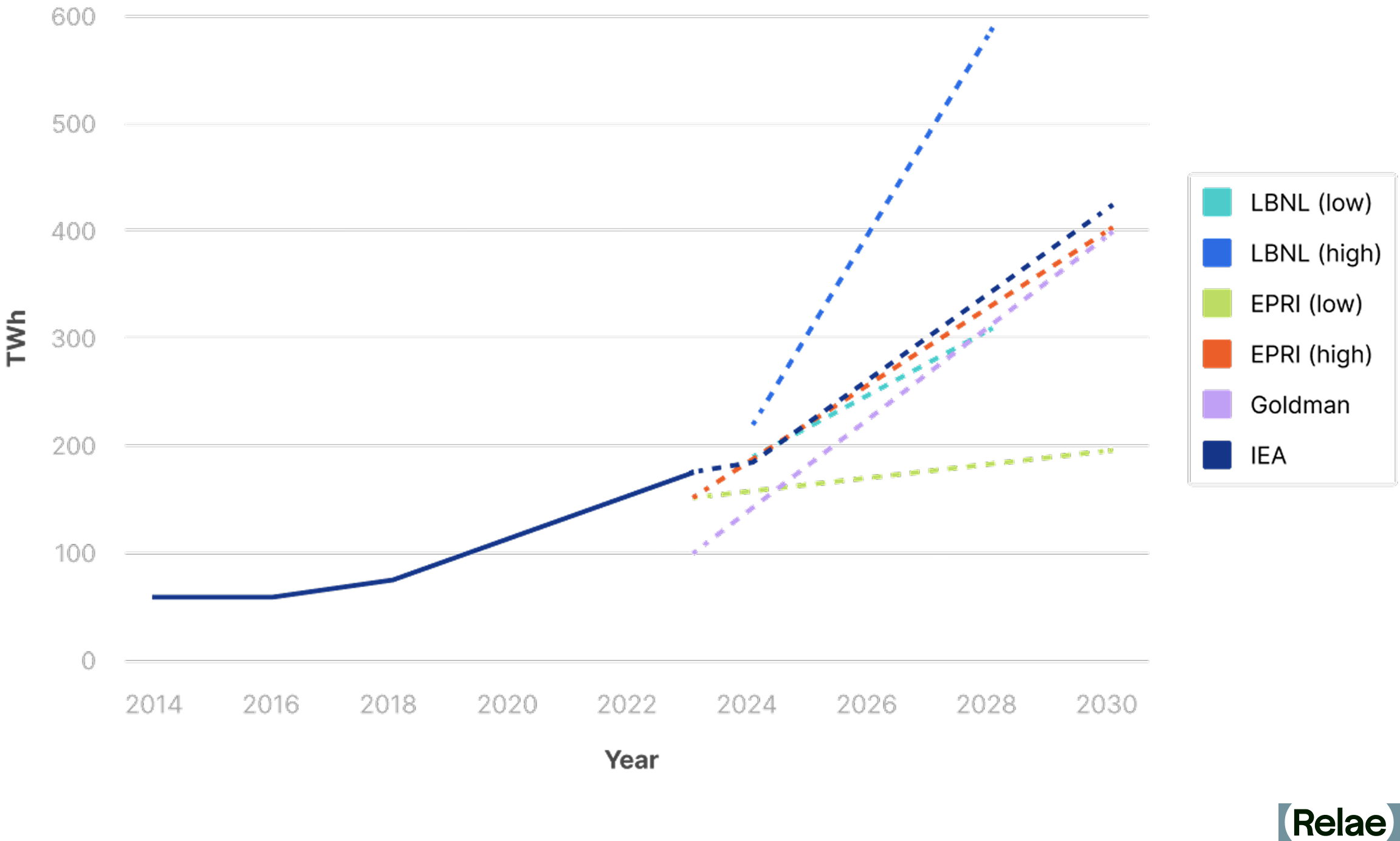
Meanwhile, new renewable projects face headwinds. Smith points to interconnection queue delays: "Solar and battery projects are taking three to five years from initial request to operation." At the same time, clean energy tax credits, which were driving wind and solar expansion, have been curtailed. New restrictions on foreign supply chain materials, which are critical to renewable project development, are further hampering the development of new clean electricity projects.
The result: Power demand is rising while new renewable electricity supply is getting throttled.
The Messy Reality of Electricity Emissions Accounting
Quantifying the emissions from an individual power plant is straightforward. Allocating those emissions to the companies that consume power is far more complicated.
Grid-supplied electricity comes from many generators that shift constantly, sometimes even second to second. Companies can’t directly measure emissions from a grid-connected load because the generators serving it continuously change.
Without direct measurement, companies need rules to estimate the emissions they are responsible for. The GHG Protocol’s Scope 2 Guidance provides that framework, establishing how companies estimate electricity-related emissions and how to reduce them through renewable energy purchases.
How Companies Currently Claim Renewable Energy
For the past decade, companies have used renewable energy purchases to achieve their scope 2 emission reduction goals. The most widely used mechanism is the REC, each representing clean energy attributes for one MWh of renewable electricity generated and added to the grid. Currently, when a company buys RECs equal to its annual electricity consumption, it can claim 100% renewable electricity. Under current rules, companies can use purchased renewable energy from anywhere in North America and apply it to any load in North America at any time during the year.
Importantly, emissions from different power grids vary widely across North America depending on time of day, time of year, and the power grid makeup.
This flexibility allows companies to match a REC from a clean grid against electricity consumption from a dirtier one, creating a potential mismatch between emissions claimed and actual emissions avoided. This gap has drawn scrutiny, contributing to the motivations for the scope 2 rules rewrite.
What's Changing in GHG Protocol Scope 2 Accounting?
On October 19, 2025, after years of consultation, the GHG Protocol released two separate proposals for public consultation:
1. Scope 2 changes: Moving away from annual REC matching to an ‘hourly and regional’ REC matching requirement.
2. New consequential methodology: A new approach to estimating emissions caused by a company’s consumption and avoided by its renewable energy contracts.
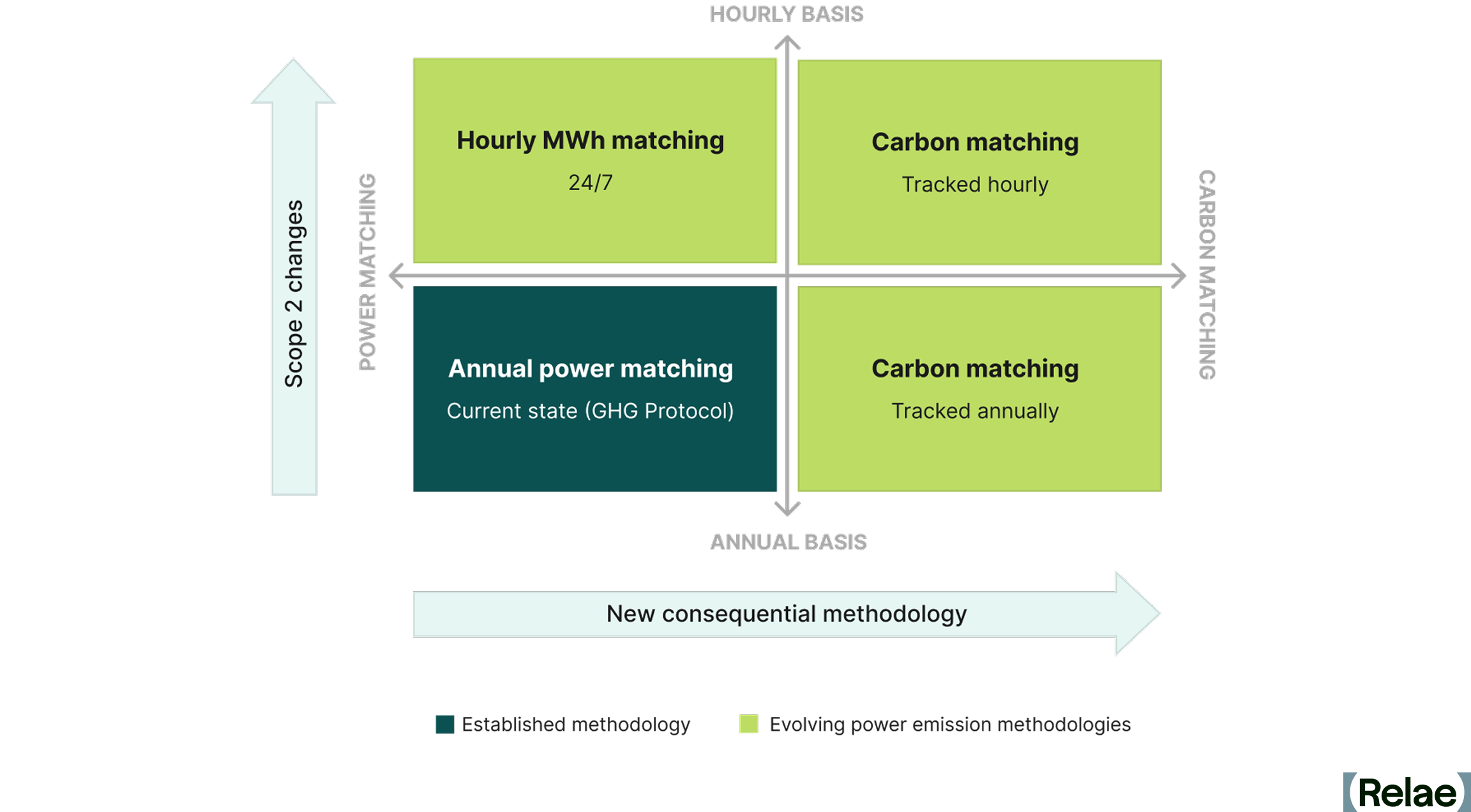
The hourly matching proposal (24/7): Companies would match RECs to consumption hour by hour within the same grid region, rather than annually across any North American grid.
"A REC generated on a Texas wind farm would not be able to be used for electricity consumed in New York," Millot explains.
The consequential approach: This proposes a carbon matching methodology, which estimates emissions caused by a load and estimates the emissions a renewable project displaces.
"Projects in the Carolinas are avoiding 0.6 or 0.7 tons of CO2 per megawatt hour, whereas a California project is probably closer to 0.2 or 0.3," Smith explains.
Projects in the Carolinas deliver more than double the climate impact per REC under the consequential rules. In this methodology, the load and generator do not need to be located in the same region.
While the proposed rules and new methodologies work through the public consultation process, it will be important for companies to start to anticipate the potential impacts on their climate goals and strategies.
Timeline for Scope 2 Accounting Changes
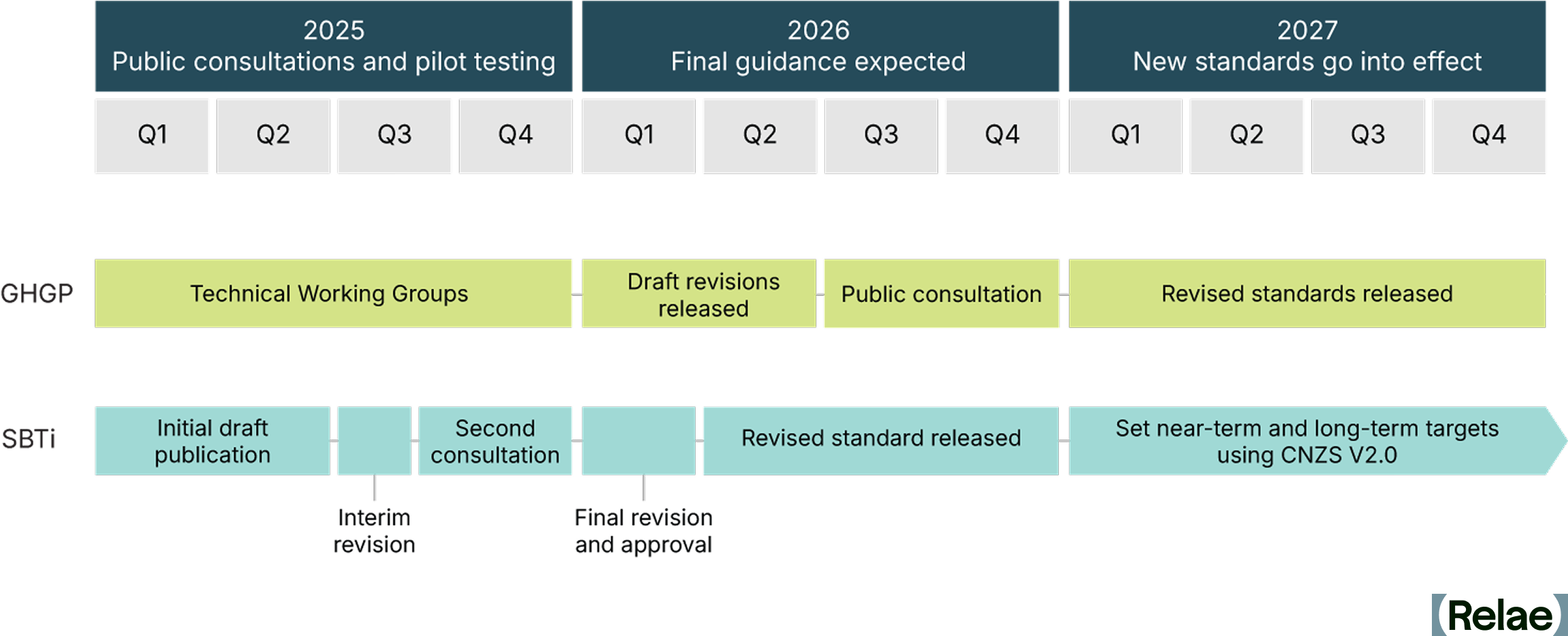
Both the Scope 2 and Consequential Electricity-Sector Emissions consultations closed January 31, 2026, after GHG Protocol extended the original deadline. The GHG Protocol is analyzing feedback with a second consultation and final standards expected by 2027, though the exact timeline is still being finalized.
Companies are encouraged to participate in the public consultation. The GHG Protocol is asking for comments on critical questions, such as:
- Should proposed rules apply to energy consumers of all sizes?
- Which geographical boundaries should be used for locational matching?
- Should existing contracts be grandfathered in?
The public consultation period is an opportunity to shape the standards that will govern electricity-related emission accounting for years to come.
Why Act Now Instead of Waiting
With final rules still in development, companies with scope 2 emission reduction goals or science-based targets face a decision: Wait for clarity or act now.
Several factors favor early action:
- Inclusion of legacy contracts. "There are a lot of indications from the committees that existing long-term contracts will be grandfathered in," Pearce notes. The draft considers a legacy clause that would allow organizations to apply pre-existing contractual agreements, even if they don’t comply with new rules.
- Throttled renewable project development. Interconnection delays for new renewable energy projects, elimination of clean energy tax credits by 2028, and limitations on foreign materials needed to develop renewable energy project components mean that new REC supply may be harder to access in future years.
- Renewable project development timelines. "There's generally a lag, sometimes six to 18 months" between contract signing and project operation, Pearce explains. That means even if you sign today, the RECs won’t be generated for up to 18 months from the signing date.
- High-impact opportunity. Through careful project selection, renewable energy investment can go beyond the annual energy match requirement and incorporate additional impactful metrics, such as higher avoided emissions and positive social impacts.
Renewable Energy Buying Options for Companies
Previously, companies have been able to buy renewable energy through the following three paths; however, they all come with their own tradeoffs.
Traditional REC Buying Options
- REC spot markets make up most corporate renewable procurement. However, they mainly come from existing projects rather than financing new development, which is critical to expanding renewable energy supply to meet rising decarbonization needs.
- Virtual power purchase agreements (VPPAs) are highly impactful but require large power loads and the ability to manage long-term financial risks. Unavailable to most companies.
- Utility green tariffs have limited availability throughout the US (depending on the utility(s) that serve your load) and vary in quality.
Alternative REC Procurement Approach
For companies that want to go beyond the REC spot market and are not large enough to pursue a VPPA, there’s an alternative procurement option available: a high-impact forward REC contract. These multi-year contracts commit to purchasing RECs from specific new projects before they're built, providing the upfront revenue certainty developers need to secure financing at a fraction of the scale and complexity of a VPPA.
Comparing Renewable Energy Procurement Options
The Path Forward
Despite rapidly increasing grid demand, renewable project headwinds, and changing accounting rules, companies can still meet 2030 scope 2 goals.
What companies should do now:
- Watch for the next round of GHG Protocol consultation on Scope 2 revisions
- Evaluate forward REC contracts to lock in terms before rule changes
- Prioritize high-impact RECs that deliver measurable climate and social benefits
Carbon Direct (Now Relae) Acquires Pachama November 2025
Carbon Direct acquires Pachama
We founded Carbon Direct in 2020 with a clear mission: to drive climate impact through science-based carbon management. Today, we are pleased to announce exciting progress in that mission. Carbon Direct is acquiring Pachama, the leading provider of digital tools to ensure integrity in the voluntary carbon market (VCM). Pachama’s digital platform for forest carbon project monitoring, reporting, and verification (MRV) will become part of Carbon Direct, advancing our science-based mission.
I have known Diego Saez Gil, Pachama's co-founder and CEO, since Carbon Direct's founding. Like Carbon Direct, Pachama is fundamentally an evidence-driven organization, translating the latest science into actionable insights for clients. Over the last few years, Pachama has developed an advanced technology platform and ecosystem to catalyze a new generation of nature-based carbon projects and push the carbon markets to evolve.
Pachama’s tools address a critical need in climate action. Its digital MRV capabilities bring unprecedented transparency and rigor to forest carbon projects at a time when the market urgently needs both. Our shared emphasis on technical excellence, collaboration, and scale makes this acquisition a natural fit - for our companies and for the broader carbon market.
Carbon Direct will now deliver an even more comprehensive solution for high-quality carbon credit development, assessment, and management grounded in science, enhanced by technology, and designed for transparency and trust. This acquisition positions Carbon Direct to:
- Advance quality and integrity across the VCM through continuous, data-driven project evaluation.
- Enhance transparency for buyers and project developers through integrated digital MRV tools and sophisticated advisory insights.
- Expand access and scale of nature-based carbon solutions to meet growing corporate and regulatory demand for verifiable climate impact.
- Accelerate innovation at the intersection of science, technology, and nature, supporting the transition to a net-zero economy.
For our clients, this means more sophisticated digital experiences, faster project evaluations, and deeper insights into carbon credit integrity. Project developers will benefit from streamlined monitoring and verification that helps quality projects scale more efficiently.
The talented team at Pachama has built exceptional tools, and I'm thrilled that many of their team members will be joining us. The mutual respect is strong, based on a shared passion for climate science and delivering high-impact work to clients.
As Diego said, "We're incredibly proud of what the team at Pachama has built. Our technology brings transparency and integrity to forest carbon projects at scale. As we explored options for our next chapter, Carbon Direct stood out for its unwavering commitment to scientific rigor, its reputation as the most trusted voice in carbon management, and its rapid growth. This is the coming together of two mission-driven teams that can accelerate impact far beyond what either could achieve alone. I'm excited to see the technology of Pachama reach new markets as part of a company that shares our dedication to quality and our vision for scaling equitable climate solutions."
I am excited to welcome Diego and the Pachama platform to Carbon Direct.
Jon Goldberg, Founder & CEO, Carbon Direct (now Relae)
Reconciliation Bill Dramatically Shifts the Clean Energy Landscape
Key Takeaways
- Accelerated phase-out schedules for key clean energy and decarbonization tax credits will shorten the runway for project development, which could stall or cancel projects.
- Urgency is paramount, and qualified projects should expedite construction and operational timelines to secure eligibility for existing credits.
- A more complicated policy landscape requires concerted effort to navigate, including with the support of policy professionals.
Reconciliation Rolls Back Much of the IRA
On Friday, July 4, 2025, the President signed a sweeping reconciliation bill, H.R. 1, that will add at least $3.3 trillion to the national debt and marks a pivotal, contentious moment for US clean energy policy. The law was enacted through the complex legislative process known as budget reconciliation, requiring only a simple majority of votes in the House and Senate. The new law substantially modifies or terminates many of the Inflation Reduction Act of 2022 (IRA)'s clean energy incentives and has extensive implications for the economic viability of American energy and manufacturing projects.
In the Senate, three Republicans crossed party lines to vote against the bill, requiring Vice President JD Vance to break the tie. In the House, only two Republicans broke ranks to vote against final passage. While some of the more complex provisions of the bill, such as new foreign entity of concern (FEOC) restrictions, will require more time to fully assess, we've prepared a rapid run-down of key alterations to IRA incentives for carbon management, hydrogen, and clean fuel technologies.
What Is the 2025 Reconciliation Bill?
While the 2025 reconciliation bill is staggering in length, scope, and severity, containing provisions to cut Medicaid, reduce nutrition assistance, raise the debt limit, and cut taxes primarily for the wealthy, some of the most drastic sections of the bill modify tax incentives and other public funding for clean energy and emissions reductions.
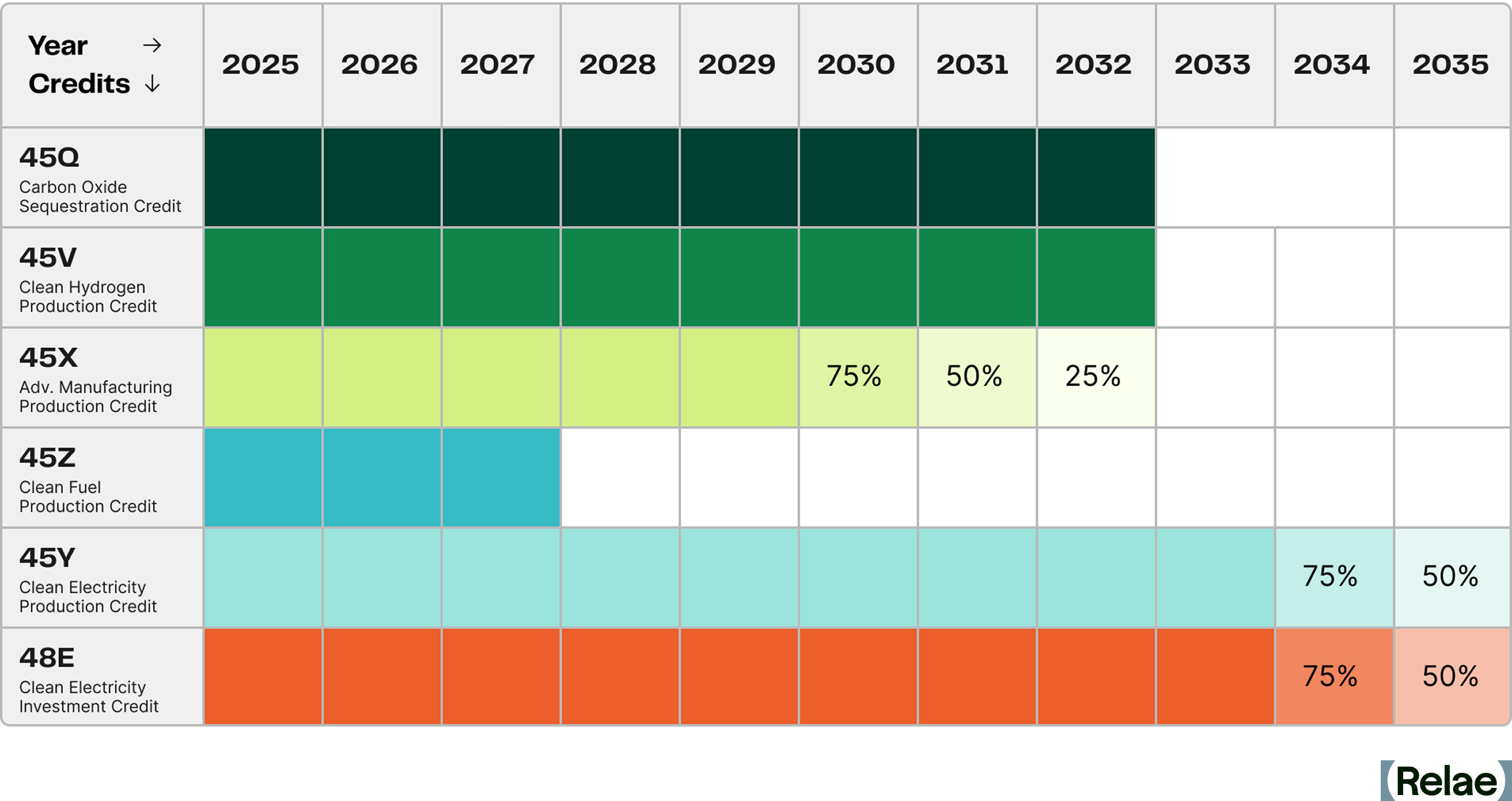
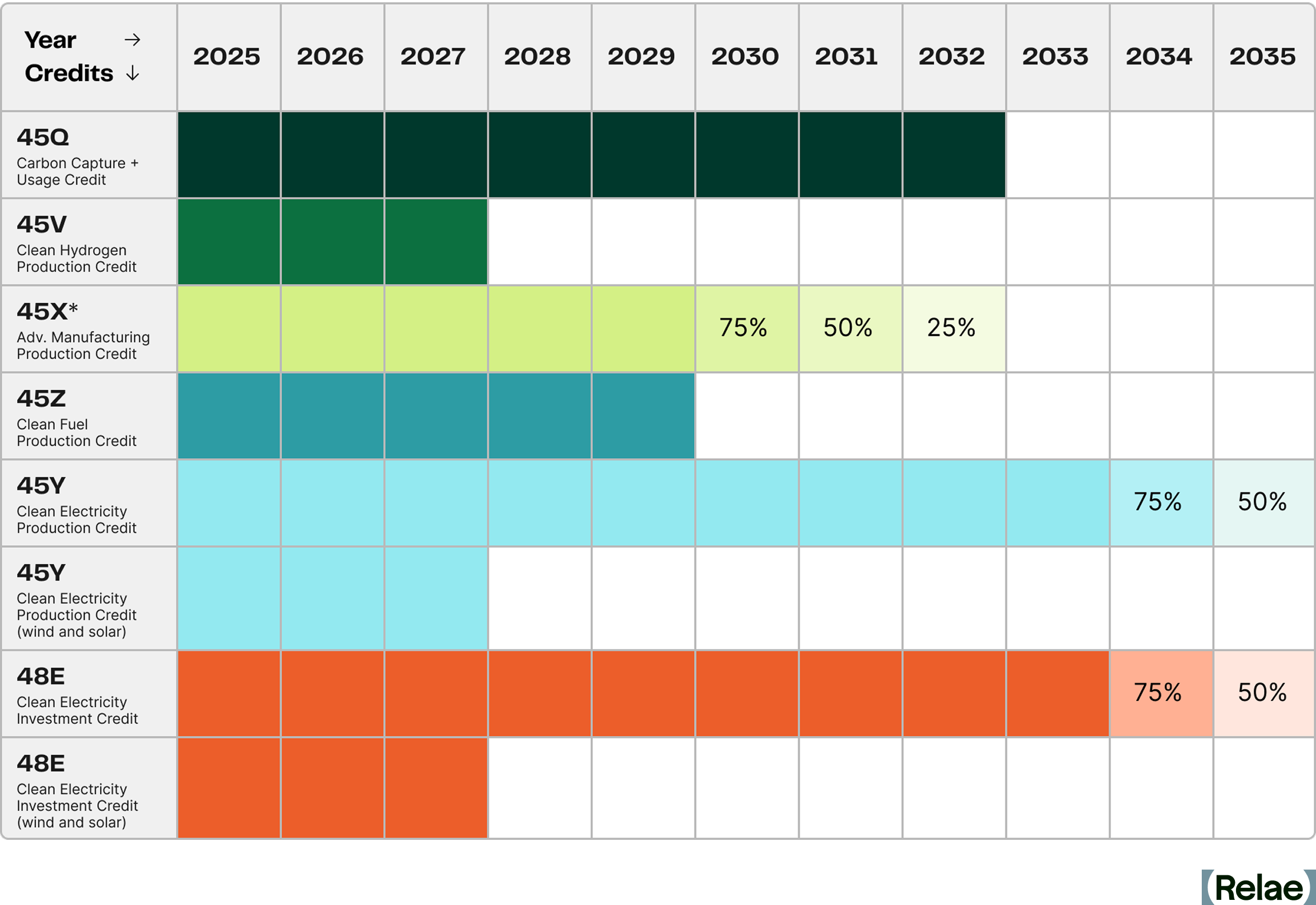
Many of the incentives to deploy clean energy that were created or enhanced under the IRA will be phased out early or repealed altogether. Credits with accelerated phase-out schedules include the newly created 45Y clean electricity production tax credit, which will no longer support wind or solar projects after 2027, and the 45V credit for clean hydrogen production for which projects must now commence construction before Jan 1, 2028 (moved up from Jan 1, 2033).
Since the passage of the reconciliation package, there has been active litigation on several provisions, including an order from a federal district court to vacate IRS guidance that would have prohibited certain wind and solar projects from securing safe harbor. The table below provides a detailed breakdown of key changes to major tax credits between the original IRA, the draft that moved through Committees in the House, and the final text that was passed by the Senate and signed into law.
Major Tax Credit Changes in the Reconciliation Law
How FEOC Restrictions Threaten Clean Energy Supply Chains
Many clean energy tax credits include ambiguous language restricting projects connected to FEOC, complicating supply chains and creating new problems for developers of clean energy projects. The law also introduces a complex matrix of new definitions, such as "Prohibited Foreign Entities," which includes both "Specified Foreign Entities" and "Foreign-Influenced Entities."
The FEOC restrictions embedded in the reconciliation bill represent a seismic shift for clean energy developers. These new rules, designed to limit the influence of Covered Nations (China, Russia, North Korea, and Iran), will disqualify projects from receiving tax credits if they source components, minerals, or intellectual property from entities tied to these nations. In other instances, the partial ownership or investment of an entity with financial ties to a Prohibited Foreign Entity may also disqualify a project from qualifying for tax credits.
This FEOC language matters for developers and investors because of the resulting global supply chain disruptions, investment uncertainty, and compliance burdens. The clean energy sector is deeply reliant on global supply chains, especially for solar panels, batteries, and wind components, industries where China currently dominates. The IRA intended to counter this by moving the manufacturing and production of these supply chains to the US. Project developers must now thoroughly review their supply chains and capital providers, and may need to quickly pivot to compliant resources.
In February 2026, the IRS released interim guidance on the FEOC provisions to provide safe harbor guidance for clean energy manufacturing, investment, and production credits to help taxpayers gauge whether material assistance was provided by a prohibited foreign entity.
Other Major Rollbacks to the IRA
Beyond clean energy tax credits, the reconciliation package also repeals and rescinds many other IRA provisions. This includes a full rescission of all unobligated IRA appropriated balances at the Department of Energy's Loan Programs Office, and several other programs, including:
- The Tribal Energy Loan Guarantee Program
- Greenhouse Gas Reduction Fund
- Transmission Facility Financing
A complete list of rescissions of energy-related funding is outlined in Sections 60001-60024 and 50402 of the law. These rescissions represent tens of billions of dollars in lost climate investments made under the IRA, which would have provided funds to state, local, and Tribal governments, federal agencies, non-profits, and commercial project developers to reduce emissions and update critical infrastructure.
What Can Project Developers and Other Companies Do?
Developers will need to act quickly to meet updated commence construction and place into service requirements, though circumstances are technology specific (e.g., safe harbor updates to 48E and 45Y). Tax credits generally have advanced commence construction and operational deadlines, resulting in a strong first-movers advantage. Companies should also review their supply chains and revise equipment and material procurement sourcing plans as necessary to address restrictions presented in the reconciliation bill.
An executive order from President Donald Trump issued on July 7 will further complicate how companies proceed. In the EO, the President directs his administration to "strictly enforce the termination of […] 45Y and 48E […] for wind and solar facilities." The Administration will likely issue extremely strict interpretations of "commence construction" clauses and FEOC requirements in forthcoming tax credit guidance issued by the Treasury Department, though these moves are quite likely to face litigation.
The new restrictions being proposed by the Administration, including specific details on FEOC, qualified equipment, commence construction, and other reporting requirements, will require additional guidance from the IRS and provide an opportunity for engagement through public comment. It is important that impacted companies weigh in during these public comment periods, not only to help inform and influence the final rules issued by the Administration, but also to build an administrative record that could support litigation efforts to strike down the final rules.
Staying Ahead of Policy Changes
Given the rapidly shifting landscape of energy policy, it's paramount that companies stay abreast of the latest changes and dedicate resources to understanding how they may be affected. Policy professionals, including the experts at Relae (formerly Carbon Direct), can support organizations as they engage in the regulatory process, anticipate and prepare for new legislation, and navigate the requirements to access essential tax credits and incentives. Even under new constraints, expert guidance can help maximize impact and minimize disruption.
Frequently Asked Questions
How does the reconciliation bill change the timelines for major clean energy tax credits?
Most clean energy tax credits saw their windows shortened relative to the original IRA:
- The 45Y and 48E credits now terminate entirely for wind and solar facilities placed in service after December 31, 2027, with a separate phase-down (75% in 2034, 50% in 2035, 0% after) for other technologies.
- The 45V clean hydrogen credit's "commence construction" deadline moved from December 31, 2032 to December 31, 2027.
- The 45Z clean fuel credit now ends on December 31, 2029 (versus 2027 in the original IRA, but bonuses for SAF have been removed and new emissions-calculation methods favor corn ethanol).
- Notably, the 45Q carbon capture credit saw little change and retained transferability, with credit values for enhanced oil recovery and utilization raised to match secure geological storage.
What are the FEOC restrictions, and why do they matter so much for developers?
FEOC ("Foreign Entity of Concern") restrictions disqualify projects from tax credits if they source components, minerals, or intellectual property from entities tied to China, Russia, North Korea, or Iran. Even partial ownership or investment ties to a "Prohibited Foreign Entity" can trigger disqualification. The definitions are complex and still being clarified through IRS guidance, meaning developers need to review supply chains and capital providers carefully and may need to pivot to compliant sourcing.
What should project developers do now in response to these changes?
Developers should move quickly to meet the earlier "commence construction" and "placed in service" deadlines, since credits now benefit early actors. This includes reviewing and potentially restructuring supply chains and procurement plans to address FEOC restrictions, and closely monitoring forthcoming IRS/Treasury guidance.
What Is Biochar? A Carbon Removal Solution Gaining Ground
Key Takeaways
- Biochar is the fastest-growing durable carbon removal method in the voluntary carbon market, accounting for 93% of all durable removal volumes contracted in the first quarter of 2026 alone.
- Scientists still have an incomplete understanding of biochar durability in soils, and there is some uncertainty regarding biochar's ultimate climate impact.
- Biochar carbon removal crediting must reflect conservative, science-based estimates of durability to safeguard against overcrediting.
- Relae’s (formerly Carbon Direct) detailed analysis highlights the key scientific issues affecting biochar soil durability to better inform credible carbon removal.
Biochar Is Gaining Momentum in Carbon Removal
Biochar has entered the spotlight as a scalable climate solution. It is being adopted for its carbon storage potential and agricultural co-benefits. Commercial uptake of biochar has expanded dramatically since 2019 and continues to accelerate, due to the voluntary carbon market. In the first quarter of 2026 alone, 2.3 million tonnes of total durable carbon dioxide removal (CDR) have been contracted, with biochar accounting for 93% of that volume, driven substantially by a single Microsoft-Liferaft deal for one million tonnes. Established and emerging CDR registries have developed biochar protocols and are certifying biochar carbon credits.
In addition to CDR, biochar can bring numerous co-benefits when it is applied to soil. These benefits include improved water and nutrient retention, pH adjustment, and pollution remediation. In agricultural and forage systems, improvements in soil quality following biochar application can lead to enhanced plant growth. Biochar also promotes rural economic development and can be a part of a circular economy that stewards its resources judiciously.
As purchases of biochar credits grow, a central question has not yet been fully answered: How durable is biochar carbon storage, and what are the best methods to assess this? This blog explores the science of biochar durability, also known as permanence, and how credible science can inform the carbon removal market.
What Is Biochar and How Is It Made?
Biomass heated in an oxygen-deficient environment produces biochar, a solid, carbon-rich material. In the near or full absence of oxygen, that process is called pyrolysis. Biochar can be produced from various kinds of biomass, including agricultural or forest residues, construction debris, organic waste, seaweed, and more. Biochar is also gaining attention for its potential as an ingredient within engineered materials, such as cement.
Biochar achieves CDR by durably storing carbon dioxide (CO₂) that was removed from the atmosphere via photosynthesis and plant growth. Carbon stored in living plants will stay stored during the plant’s lifespan. Once it dies, a plant’s biomass decomposes, cycling most of the stored carbon back into the atmosphere. By introducing technological interventions into this carbon cycle, such as using pyrolysis to produce biochar, the carbon that nature captured via photosynthesis can be stored longer than it would have been otherwise. Pyrolysis converts some of the carbon from biomass into chemical compounds with a higher resistance to environmental degradation. How much carbon converts to these more recalcitrant forms depends on the type of biomass used and the heating conditions, including temperature and time. After biochar is produced, the highly recalcitrant fraction of carbon can be stored for long periods of time, as long as the biochar does not combust.
Common methods of biochar production include:
- Industrial pyrolysis systems: Modern pyrolysis systems heat biomass in a low or no-oxygen environment, creating biochar and gaseous compounds known as synthesis gas. Synthesis gas is typically combusted in a controlled system to provide heat for the system. Low air emissions can be achieved for these systems, which is important to maximizing the environmental benefits of biochar production.
- Modular pyrolysis systems: Smaller, transportable pyrolysis units serve farm-scale or decentralized production. Unlike open kilns, these systems retain temperature control and sensor-based monitoring similar to industrial pyrolysis, and some use autothermal designs that recycle non-condensable gases for heat rather than relying on an external energy source. This makes them a middle option for smaller producers seeking more process control and emissions oversight than open-kiln methods allow, without the capital cost of a large, fixed industrial plant.
- Kon-Tiki kilns: This is a less complex and, therefore, more widely deployable method of biochar production. However, air pollution from this method is likely to be higher than from industrial pyrolysis and can be significant enough to undermine the carbon benefits of biochar production. In Kon-Tiki kilns, biomass is burned in an open-top, conical kiln. Biomass is continually added to the process and finally quenched with water.
- Trench mounds: Trench production is one of the simplest forms of biochar production and is used often by smallholder farmers. Biomass is buried in a trench, covered, and combusted to produce biochar. Air pollution from tench mound production is likely to be significant and even higher than from Kon-Tiki kilns.
How Biochar Durability Is Quantified
Durability, or permanence, is a key metric used to quantify carbon removal from biochar; it describes the amount of carbon that remains stored in biochar for 100 years or more after it is applied to soil.
Quantifying durability relies on experiments and models to project permanence. There are a number of established and emerging approaches to evaluating biochar recalcitrance to chemical decomposition and storage permanence. Most of these are based on short-term incubation experiments in laboratories, where scientists seal biochar in a container with other organic matter and measure carbon changes over a period of weeks to months. These approaches typically treat biochar as having multiple pools of carbon that differ in their ability to resist decomposition.
While these experiments offer insights into decomposition dynamics, they have two significant limitations. First, these approaches do not measure biochar decomposition and durability in the real world (e.g., after biochar is applied to agricultural soils), meaning they do not capture the effects of actual soil and other environmental factors. Research has shown that different soils can strongly influence decomposition rates. Second, the short duration of these experiments means there is significant potential for error in extrapolating the results to time periods of centuries and beyond.
Why Quantifying Durability Accurately Is Critical
Biochar CDR certification methodologies use a range of approaches to quantify permanence. Most commonly these are based on biochar’s chemical composition, namely the hydrogen-to-organic-carbon ratio (H/Corg). Models that correlate H/Corg with projected permanence, from decay models applied to biochar decomposition experiments, are used to calculate a permanence factor. Other quantification methods include measuring the random reflectance of biochar to estimate the amount of highly recalcitrant carbon in biochar.
The risks of inaccurate durability estimates for carbon removal buyers are significant. Overestimating durability can lead to ineffective CDR spending, reputational risk from overstated climate impact, and delayed progress on net-zero and compliance goals. Buyers need to understand and engage with durability estimation methods to ensure they are procuring high-quality biochar credits.
Why Underground Coal Isn't a Valid Durability Comparison
Recent research proposes a new approach to quantifying biochar durability. The authors assert that random reflectance—a parameter developed in the field of organic petrology (the study of organic matter in rocks)—can be used to characterize durability. Using a component of coal (known as "inertinite") as an analogue for biochar, they propose a benchmark random reflectance of 2% as an "inertinite benchmark" for biochar. They argue that the entire fraction of biochar that meets that benchmark will degrade over approximately 100 million years. This is a large departure from other estimates of biochar durability, and we believe this to be at odds with more conservative models.
There are several reasons to doubt this method. The coal-biochar analogy is inadequate because coal buried underground is not exposed to the same degradation conditions as biochar in soil. Underground coal has lower exposure to oxygen, water, and ultraviolet light, all of which are plentiful in surface soils. Each of these is associated with well-understood decay mechanisms. Furthermore, the process of geologic burial dramatically changes the physical structure of organic matter. Additionally, the permanence factor that the reflectance method allows (i.e., up to 100% carbon retention over extremely long time scales) contradicts experimental evidence that some carbon loss will occur over years or decades.
Subsequent research from the same authors has since recommended pairing random reflectance analysis with H/Corg rather than relying on either alone. This is a refinement of the original approach meant to support more reliable quantification of biochar durability and avoid overcrediting CDR from biochar.
Where Biochar Science Is Headed Next
Biochar stability science will keep advancing. Research into biochar degradation pathways in soil will continue to refine permanence models and inform the relevance of coal analogues. Long-term field measurement studies, with a high density of in-soil sampling to quantify persistence over time, should be a near-term priority that biochar CDR projects can contribute to. Additional studies should investigate pathways to increase durability and rigorously develop modern isotopic, spectroscopic, and chemical techniques for enabling robust assessments of biochar durability.
Crediting Biochar Means Getting Durability Right
Biochar is a promising solution for both soil health and climate impact. Nevertheless, carbon removal certification protocols will need updating as the science of biochar durability evolves. Relae cautions against excessively generous claims of biochar CDR durability, in both permanence factor and timeframe, given the important uncertainties outlined above.
Protocols should not outpace science in terms of permanence assessment, and crediting should stay rooted in an understanding of what drives biochar permanence that is backed by science, including production conditions (e.g., high temperatures) and biochar composition (i.e., low H/Corg). At a time when investment in biochar is booming and the science of biochar is evolving, the voluntary carbon market must keep pace.
Frequently Asked Questions
Is biochar carbon negative?
Biochar can provide net carbon dioxide removal when the amount of carbon durably stored exceeds the emissions associated with producing, transporting, and using the biochar. Plants capture CO2 from the atmosphere through photosynthesis and store that carbon in biomass. Left alone, most of that carbon returns to the atmosphere within years to decades as the biomass decomposes or burns. Converting biomass to biochar stabilizes a portion of that carbon into forms that can stay stored for centuries or longer, delivering a net removal once those production emissions are accounted for..
Is biochar considered an engineered, hybrid, or nature-based carbon removal solution? Biochar is considered a hybrid carbon removal solution because it combines natural carbon uptake through photosynthesis with a technological intervention. Biomass first removes and stores atmospheric carbon as it grows, and pyrolysis then converts a portion of that biomass carbon into more stable forms that keep carbon from returning to the atmosphere for longer periods.
How do carbon removal registries currently estimate biochar's durability? Registries use decay models based on biochar's ratio of hydrogen to organic carbon (H/Corg ratio), which correlates with how resistant the biochar is to microbial breakdown, combined with environmental factors where biochar is applied, like soil temperature, moisture, and application context, to estimate what fraction of the carbon remains stable (i.e., not converted back to CO2) over a defined timeframe. Methodologies typically also require third-party lab testing of feedstock and pyrolysis conditions to substantiate durability claims. Some registries and methodologies also incorporate random reflectance as part of durability quantification, although the scientific basis for using reflectance to estimate long-term biochar durability remains under debate.
How long does biochar actually store carbon?
Biochar does not have a single storage lifetime. Some of its carbon decomposes relatively quickly, while more stable fractions can remain stored for centuries or longer, depending on the biochar’s properties and the conditions where it is stored. Because these estimates rely on models rather than direct observation, carbon crediting has to balance two risks: crediting more durability than actually exists, and being so conservative it undercredits real removals and threatens project viability.
The Role of Improved Forest Management for Carbon Dioxide Removal
Key Takeaways
- Improved forest management (IFM) increases measurable long-term carbon storage in living trees and durable wood products.
- At the same time, it can provide strong social and ecological co-benefits.
- IFM projects like the ones developed by Weyerhaeuser and the Indigenous community of Petcacab in collaboration with Relae (formerly Carbon Direct) show how IFM practices can align climate goals with social and environmental benefits.
Forests Are Climate Solutions If We Manage Them Wisely
Forests remove carbon dioxide from the atmosphere, but they need to be thoughtfully managed to keep doing so. As buyers look to scale carbon removal, improved forest management (IFM) is gaining traction in the voluntary carbon market (VCM).
IFM focuses on enhancing how existing forests are managed to increase carbon storage over time. It’s a nature-based solution that supports climate outcomes, community livelihoods, and environmental benefits when done well.
This piece explains how IFM works, what makes a project high-quality, and how real-world IFM projects like those developed by Weyerhaeuser and Petcacab in collaboration with Relae (formerly Carbon Direct) are delivering credible results for buyers and local communities alike.
What Is Improved Forest Management?
Improved forest management is a catch-all phrase that describes management techniques that decrease emissions from forests or increase carbon removal and storage. Some management techniques, like transitioning a working forest to a conserved status, decrease emissions from forest harvest and primarily create credits for avoided emissions. Other management techniques, like harvesting forests less frequently, can lead to greater carbon removal and storage over time and create credits for additional carbon removal.
Examples of IFM Practices Include:
- Extending harvest rotations to allow more carbon accumulation
- Reducing the impact of logging on soil and surrounding trees
- Managing fire and pest risks to enhance forest health
- Transitioning some of a forest to conservation status
These strategies help forest carbon stocks grow beyond business-as-usual baselines. In carbon markets, IFM can generate carbon removal or avoided emissions credits, depending on the project's design and carbon accounting methodology.
What Makes a High-Quality IFM Carbon Removal Credit?
Buyers today face increased scrutiny around carbon credit quality. In this context, IFM projects must go beyond basic registry standards to demonstrate climate integrity and social and environmental benefits.
Relae developed the Criteria for High-Quality Carbon Dioxide Removal, an annual report published in collaboration with Microsoft to establish science-backed quality standards. This includes six core principles that define high-quality carbon removal, all of which apply to IFM projects:
- Social harms, benefits, and environmental justice - The extent to which the project prevents new social harms to people and communities, reduces existing harms, and provides meaningful benefits distribution. Since IFM projects take place in communities around the world, benefits will naturally vary from project to project.
- Environmental harms and benefits - The extent to which the project minimizes and mitigates environmental harms, as well as provides environmental benefits. Because IFM projects enhance management practices, environmental co-benefits of high-quality IFM projects are usually substantial.
- Additionality and baselines – Evidence that the project’s carbon removal would not have occurred without carbon finance. Many IFM projects fail to present compelling additionality data and narratives. High-quality projects will be able to identify the actions the project took to increase carbon storage that would not have happened without carbon finance.
- Measurement, monitoring, reporting, and verification (MMRV) – The ability to accurately quantify carbon removal in a repeatable and verifiable way, and to develop a plan for long-term monitoring of the project. IFM projects must have robust forest inventory, growth modeling, and occasional remeasurement to verify the additional carbon storage.
- Durability – The likelihood that removed carbon remains stored over time, with mechanisms in place to mitigate reversal risk. Enhanced management of fire, pests, and disease in IFM projects can enhance forest carbon durability.
- Leakage – Evaluation of whether project activities cause increased emissions elsewhere. If an IFM project substantially reduces timber supply, market demand can drive increased harvesting in other forests, undermining some of the project’s climate benefits. High-quality IFM projects minimize this risk by limiting harvest reductions, and account for any remaining leakage by issuing fewer credits.
Relae uses these criteria as part of our diligence framework when advising buyers evaluating projects and co-developing our own projects.
IFM Projects Delivering Real Impact
Weyerhaeuser: Applying Science at Scale
Weyerhaeuser, one of the largest forest owners in North America, is applying improved forest management practices across over 200,000 acres of working forests.
The IFM projects led by Weyerhaeuser are located in rural areas in the US, with low wildfire risk. These IFM projects sequester carbon by extending harvest rotations and forgoing harvest in established streamside management zones.
Relae supported Weyerhaeuser with hands-on scientific collaboration to confirm that every IFM project met the Criteria for High-Quality Carbon Dioxide Removal.
Why it matters to buyers:
- High-quality climate impact at large scale
- Transition of working forests from traditional management techniques to maximize climate impact
- Responsible forestry practices aligned with SFI® standards
- Rigorous carbon accounting and high-quality project baseline established using historical harvest records
The IFM projects led by Weyerhaeuser are some of the largest in the US today and a model for scaling science-backed forest carbon solutions.
Petcacab: Indigenous-Led Conservation in the Yucatán Peninsula
Located in the communal lands of Petcacab, Mexico, this IFM project is led by Indigenous Mayan ejidatarios—community members who have legal rights to manage the land.
Historically, forests in the ejido have been degraded through unsustainable harvesting and extensive damage from hurricanes. Through carbon finance, they are developing new forest management plans and sustainable forestry models, with revenue reinvested in health, education, and job creation.
“The rainforest for me represents my home, my work, my present, my future. We have a very daring challenge: to transform how we manage our forest, shifting from harvesting and selling timber to conserving it through the sale of carbon credits that support the development of our community.”
— Celso Chan Rivas, Carbon Project General Manager
What makes Petcacab stand out:
- Equitable benefit-sharing and strong Indigenous governance
- Critical habitat protection for endangered species
- Increased additional carbon storage through forest management and reduced land use conversion
- Transparent reporting and verified outcomes
Petcacab is recognized by Relae as a high-quality community IFM project in Mexico, with clear social, environmental, and climate outcomes.
Investing in Forests That Deliver More Than Carbon
Improved forest management is more than a carbon strategy, it’s an investment in ecosystems, communities, and long-term impact. For buyers seeking high-integrity carbon removal with social and environmental co-benefits, IFM projects offer a compelling opportunity.
IFM projects like the ones developed by Weyerhaeuser and Petcacab in collaboration with Relae show what’s possible when forests are managed with science and care. They also reflect what the voluntary carbon market needs more of: quality, transparency, and impact beyond the metric ton.